Let us know how we can help
Sales & Pricing
Speak to a rep about your business needs

Help & Support
See our product support options
General inquiries and locations
Contact us


Enterprise Data Pipeline Orchestration Across Batch, Streaming, and Cloud
Orchestrate, monitor, and recover data pipelines across hybrid, multi‑cloud, and on‑prem environments—with built‑in SLAs, governance, and end‑to‑end visibility.
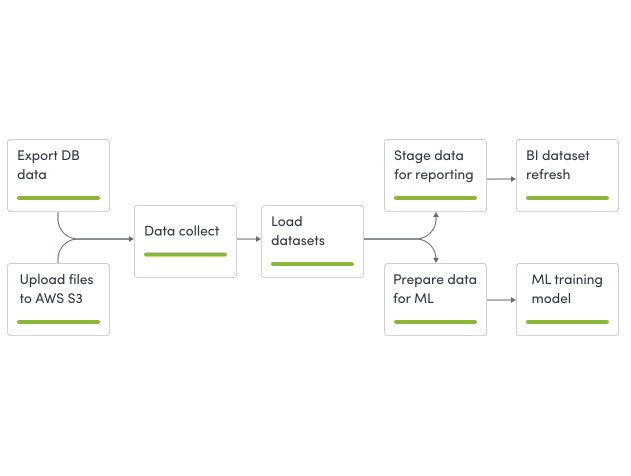
Enterprise data pipeline orchestration with Control-M turns complex, multi-platform data pipelines into a single, manageable workflow to drive dependable business outcomes.
When Data Pipeline Orchestration Becomes an Operational Problem
At scale, the challenge with enterprise data pipelines isn’t building them, it’s running them reliably across platforms and production SLAs. Tool‑level orchestration works in isolation but breaks down once pipelines must run together.
When that happens, visibility degrades, failures span systems, and operational risk increases.
The issue isn’t complexity, but coordination. Someone needs to ensure execution, deadlines, and failure handling are managed consistently across systems.
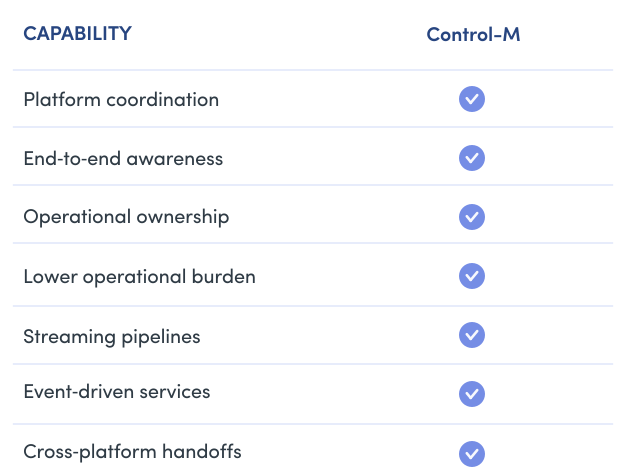
What Teams Evaluate in an Orchestration Platform
At this stage, teams stop comparing features and evaluate operability:
-
Can data pipelines be orchestrated across platforms, not just within one stack?
-
Are end-to-end dependencies visible, including downstream consumers?
-
Are SLAs enforced at the pipeline level, not tracked elsewhere?
-
Can operations teams manage reliability without rewriting pipelines?
-
When failures happen, is recovery controlled or improvised?
-
Does the platform support DataOps operating models, where pipelines are treated as long‑running production services with shared ownership between engineering and operations?
Takeaway: Once pipelines span platforms and business impact, schedulers alone are rarely sufficient. Teams need centralized data pipeline orchestration.
Why Enterprise Teams Centralize Data Pipeline Orchestration
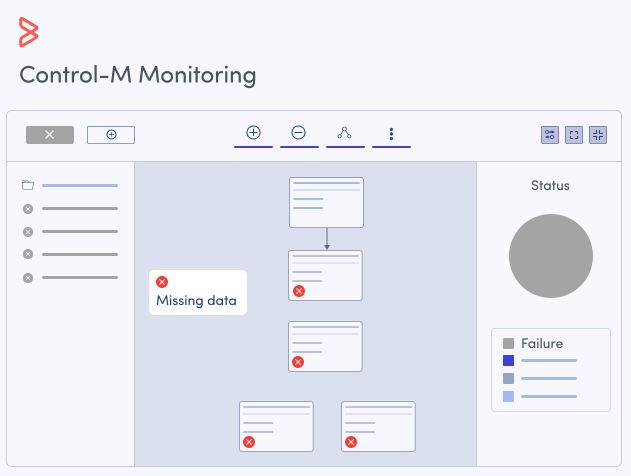
Enterprise teams centralize data pipeline orchestration to gain the following advantages:
-
Coordinate work across platforms:
Batch jobs, streaming pipelines, event‑driven services, and downstream processes (including Kafka‑based and cloud‑native streaming workloads) are managed as a single end‑to‑end flow instead of separate systems.
-
End‑to‑end dependency awareness:
Upstream delays, downstream impact, and cross‑platform handoffs are visible as part of the same pipeline, allowing teams to act before SLAs are missed.
-
Clear operational ownership:
SLAs are enforced at the pipeline level, failures follow defined recovery paths, and teams can answer operational questions without stitching together tools.
-
Lower operational burden:
Teams spend less time compensating for gaps between tools and more time keeping data pipelines running reliably.
How Control-M Orchestrates Data Pipelines End to End
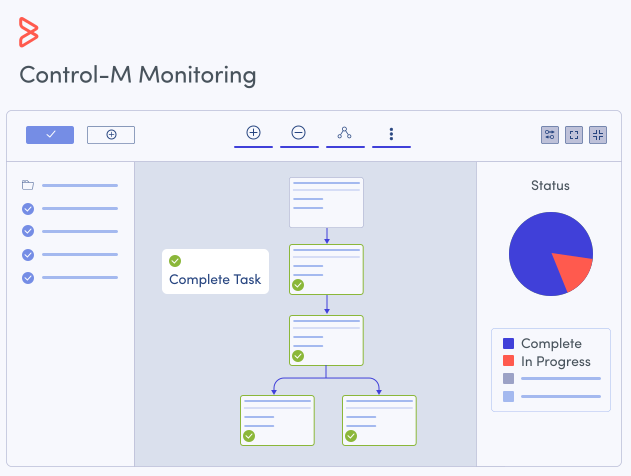
Control‑M orchestrates enterprise data pipelines as connected flows across systems, not isolated tasks.
-
It starts by defining dependencies across systems
Control-M models upstream steps, downstream consumers, and cross platform handoffs as part of the same pipeline, so work advances in the correct sequence.
-
From there, execution is coordinated across batch, streaming, and cloud services
Pipelines run in the platforms teams already use, while Control‑M controls progression end to end as dependencies are met.
-
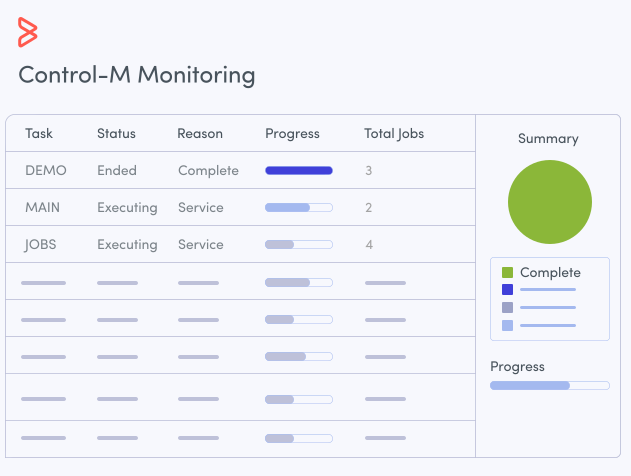
As pipelines run, Control-M tracks health and outcomes
Teams can see whether data pipelines are on track to meet SLAs, where delays are building, and what’s at risk downstream—without piecing together signals from multiple tools.
-
When something goes wrong, recovery is structured and automatic
Failures follow defined recovery paths, remediation is predictable, and manual intervention is reduced.
Control-M provides centralized orchestration across systems, so data pipelines run reliably in production, not just on schedule.
Control-M vs Tool-Level Orchestration
Enterprise teams choose pipeline orchestrators based on scope, ownership and what must run reliably in production.
Tool‑level orchestration works well for contained workflows. As data pipelines span platforms and become business‑critical, centralized orchestration is required.
The table below summarizes how these differences show up in practice.
| Dimension | Tool‑Level Orchestration (Airflow, Prefect, Native Schedulers) | Control-M |
|---|---|---|
| Primary role | Orchestrate workflows within a tool or platform | Orchestrate workflows within a tool or platform |
| Best fit | Local, single‑platform, or team‑owned workflows | Local, single‑platform, or team‑owned workflows |
| View of dependencies | Task‑ and DAG‑centric, usually limited to one environment | Reduces delays from misaligned execution |
| Operating model | Developer‑managed | More consistent SLA adherence |
| SLA management | External or manual | Lower downtime and reduced MTTR |
| Failure handling | Scripted or ad‑hoc | Easier compliance and audit readiness |
| Observability | Task execution focus | Reduced operational bottlenecks and faster execution |
| Operational overhead | Grows with scale and platform sprawl | Single pane of glass control plane |
Operating Data Pipelines with SLAs, Governance, and Control
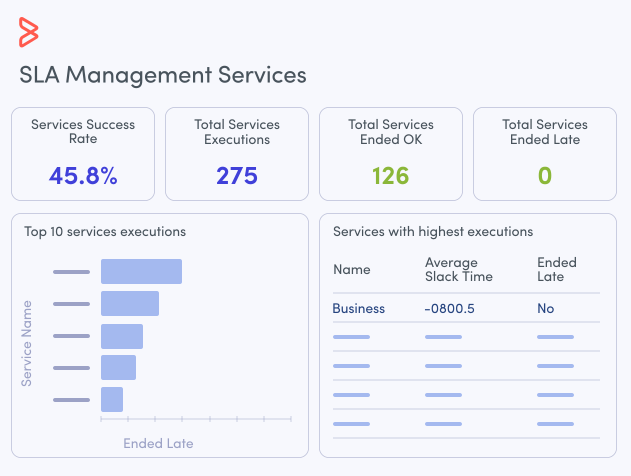
For DataOps teams responsible for production reliability, Control‑M provides a centralized orchestration and governance layer that spans batch, streaming, and cloud‑native pipelines without changing how work is built.
SLAs, governance, access, and recovery operate through the same orchestration layer—not as disconnected controls added after the fact—so pipelines run predictably as scale and risk increase.
-
SLA management
SLAs are enforced at the pipeline level, with early visibility into risk and downstream impact.
-
Governance and access control
Role-based permissions and separation of duties govern who can define, change, and run pipelines.
-
Auditability and traceability
Execution and change history are captured by default, enabling traceability without reconstruction.
-
Failure recovery
Failures follow predefined recovery paths, reducing ad hoc fixes and operational risk.
Orchestrating Across the Platforms You Already Run
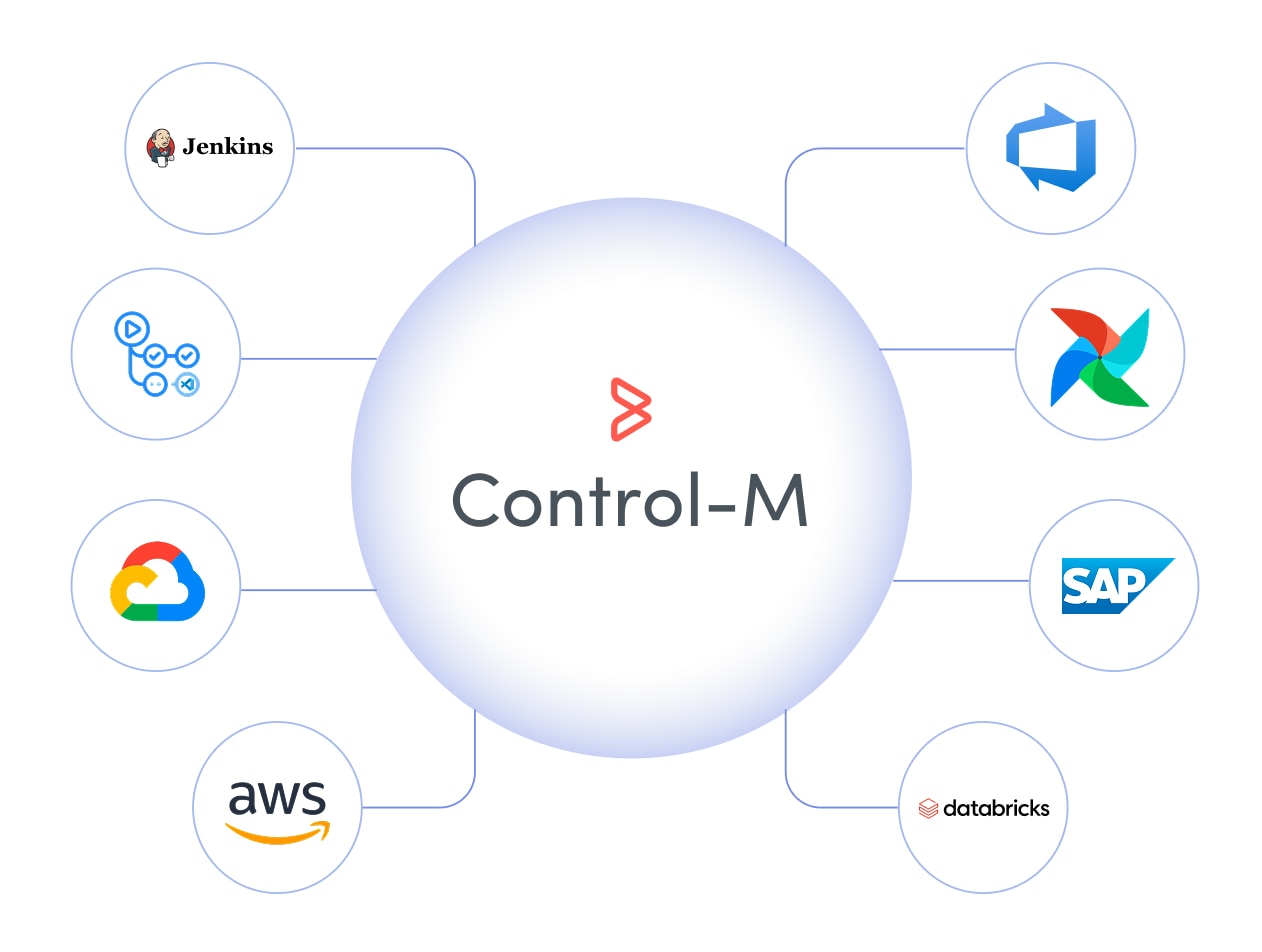
Control‑M integrates into existing environments using plug‑ins and APIs to coordinate jobs, triggers, and dependencies across platforms—without requiring teams to change how or where work runs.
Commonly orchestrated platforms include:
-
CI/CD & DevOps:
Jenkins, Azure DevOps, GitHub Actions
-
Data platforms & tools:
Apache Airflow, Databricks, Informatica
-
Cloud & serverless:
AWS (including Lambda), Azure Functions, Google Cloud
-
Databases & enterprise apps:
Oracle, SQL Server, SAP
Who Control-M is Designed For
Control‑M is designed for DataOps and operations teams responsible for running data pipelines reliably at scale, not for experimenting with isolated workflows.
Control-M best fits teams who:
-
Operate pipelines across hybrid or multi-cloud environments
-
Own business-critical workflows with real SLA impact
-
Require clear operational ownership across teams and platforms
-
Are managing growing scale and complexity in production
Takeaway: For organizations where data pipelines are foundational, Control-M provides the structure required to operate with confidence.
Step through Control-M demos:

Why Teams Choose Control-M for Data Pipeline Orchestration
It gives us the ability to have end-to-end workflows, no matter where they're running

Control-M has also helped to make it easier to create, integrate, and automate data pipelines across on-premises and cloud technologies. It's due to the ability to orchestrate between workflows that are running in the cloud and workflows that are running on-prem. It gives us the ability to have end-to-end workflows, no matter where they're running.
Richard Meyer
We have had a very good run with Control-M. I love it
With the move to big data and especially with our AWS Cloud presence, we have a data lake. We are in discussions with the analytics teams about how they can utilize Control-M in the cloud for analytics, big data, etc.
Transportation company
We use Control-M to provide business services to our customers
In our business, automation is used for many things and we use a lot of the Control-M modules. For example, we connect to SAP, with databases, Hadoop, MFT, Informatica, and other technologies.
Raul Galicia
How Enterprises Run Data Pipelines with Control-M
Running Global Digital Ordering and Analytics
Domino’s Pizza uses Control-M to orchestrate more than 3,000 data pipelines, supporting digital ordering and analytics across 20,000+ stores in 90 global markets while managing complex workflows and service-level requirements at scale.
Read more
Meeting SLAs for Critical Rail Ops
Railinc relies on Control-M to orchestrate big data workflows that process more than 11 million data points per day, supporting 1.6 million railcars across 140,000 miles of track, while managing SLAs, dual site operations, and rapid data volume growth.
Read more
Accelerating Insights, Reducing Downtime
Navistar uses Control-M to orchestrate data pipelines handling 20 million records per day, enabling five times faster creation of actionable data, saving 20 percent of engineering work time, and helping reduce vehicle downtime by upwards of 40 percent.
Read more
Get Better Control of Your Enterprise Data Pipelines
See how Control‑M fits into your architecture
If your data pipelines are getting harder to manage as you scale, you’re not alone. Evaluate how Control‑M can help you orchestrate everything—from dependencies to SLAs—so your pipelines run reliably and on time.
