Let us know how we can help
Sales & Pricing
Speak to a rep about your business needs

Help & Support
See our product support options
General inquiries and locations
Contact us


The approval isn't the story. Everything around it is.
Human-in-the-loop (HITL) approval discussions often focus on whether an AI agent's action should be approved by a human. In production, the problem is usually everything that happens around that decision. Ownership isn't clear, approvals sit unanswered, deployment windows close, or a workflow stalls because nobody realizes it's waiting on a response.
As autonomous AI agents take on more responsibility, approval workflows need to do more than collect human decisions.
Why Human Approval Gates Become Operational Messes
As agents generate more requests and trigger more actions across the business, inefficiencies that once seemed manageable quickly become operational constraints. Routing delays become bottlenecks, escalations become routine, and approval queues grow faster than teams can keep up.
As approval volume grows, workflow execution becomes increasingly dependent on human response times, availability, and decision ownership.
At that point, human approval stops feeling like a control and starts feeling like a dependency every workflow is waiting on.
What Human Approval Means for Workflow Design
A human approval decision doesn't complete a workflow. It pauses one.
Before the decision, the workflow needs to know who owns the request, where it should be routed, and how long it can wait. After the decision, it needs to know what executes next, how rejected requests are handled, and how execution resumes.
In production, those questions often determine whether the workflow succeeds.
| Approval Decision Questions | Workflow Execution Questions |
|---|---|
|
Who can approve? |
What executes once approved? |
|
Who rejected? |
Which workflow path runs next? |
|
Is approval required? |
How long can execution wait? |
|
Is there evidence? |
How does execution resume? |
|
Who owns the decision? |
What happens if nobody responds? |
|
Was policy followed? |
Can the business process be completed successfully? |
As AI agents take on more responsibility, those workflow execution questions stop being edge cases and become part of everyday operations.
Rule of thumb: Don't wait until a human approval is needed to decide what happens next. Define ownership, routing, escalation paths, timeout behavior, execution outcomes, and evidence capture before the workflow ever reaches the approval step.
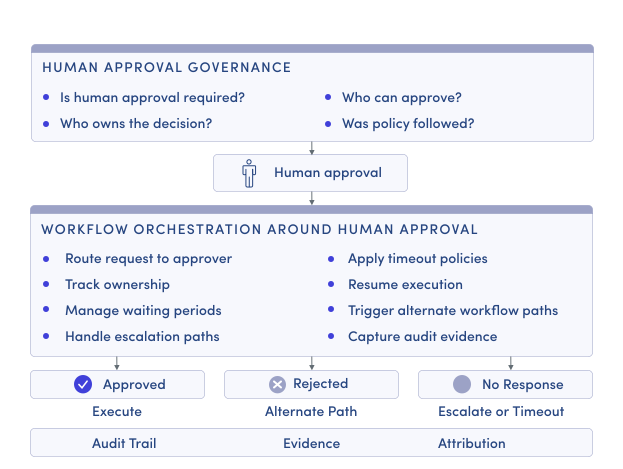
Once human approvals become part of the execution path, you're no longer designing an approval process. You're designing how the workflow operates around that approval. That's where workflow orchestration comes in: managing the routing, waiting, escalation, resume logic, and execution paths that keep the process moving.
Before orchestrating or automating anything, you need to know which business actions need human oversight.
Quick take:
Human approval determines whether an action should happen. Workflow orchestration determines whether the business process can continue before, during, and after that decision.
Where Human Approval Gates Belong
Gate consequences, not tasks.
If every AI-generated business action requires human approval, approval fatigue is inevitable. What matters is whether the agent is about to do something that could create operational, financial, customer, or compliance consequences.
Human approval gates belong at points of consequence. Before placing one, evaluate the proposed business action against three questions :
Is the action reversible?
For example:
- Drafting a report? Yes.
- Deleting customer data? No.
Does the action create external impact?
For example:
- Internal analysis? Low impact.
- Customer communication? High impact.
Does the action commit business resources?
For example:
- Recommendation? No.
- Payment release? Yes.
Actions that are hard to reverse, that affect customers, commit resources, or create regulatory exposure are strong candidates for human oversight.
What Should Humans Approve: Actions or Policies?
Once you've identified which business actions deserve human oversight, you need to decide whether humans should review those actions individually each time they occur or approve the policies and guardrails that govern them.
Some organizations require approval every time a high-consequence action occurs. Others approve the policies, thresholds, and guardrails that determine when those actions can execute automatically.
| Approving Individual Actions | Approving Policies, Thresholds, and Guardrails |
|---|---|
|
Review each deployment request |
Approve deployment rules based on testing and risk criteria |
|
Review each refund request |
Approve automatic refunds below defined thresholds |
|
Review each access request |
Approve role-based access policies for standard permissions |
|
Review each low-risk infrastructure change |
Approve guardrails that allow predefined changes to run automatically |
As AI agents become more capable, the conversation moves from "Should this specific action execute?" to "Under what conditions should this category of actions execute automatically?"
Quick take:
Mature human-in-the-loop (HITL) programs don't scale by reviewing more actions. They scale by approving better policies, thresholds and guardrails.
Four Principles for Designing Human Approval Gates That Scale
Teams that successfully scale HITL approval workflows tend to follow four design principles:
01
Let agents prepare for the decision before asking for approval.
A well-designed approval gate sits at the point of consequence, not at the point of analysis. Let the agent gather context, assemble evidence, and prepare recommendations. Pause the workflow only before an action that’s difficult to reverse.
02
Route decisions by policy.
Approval authorization should be predefined before the workflow begins waiting. The goal is to eliminate ambiguity about who owns the decision.
03
Design for non-response.
Every approval workflow should answer one question: What happens if nobody responds in time? Define timeout policies, escalation paths, alternate approvers, approval SLAs, and exception handling. Without these controls, workflows become dependent on human availability.
04
Resume execution and preserve evidence.
Once a decision is made, the workflow should automatically take the correct next step while capturing attribution, decision history, and supporting evidence. The approval becomes part of the workflow record, not a disconnected event.
What a Well-Designed Human Approval Workflow Looks Like
In a well-designed human approval workflow, every outcome has a predefined path. Whether an approver approves, rejects, or never responds, the workflow follows the appropriate path according to policy.
The human decision matters. The workflow surrounding that decision determines whether the process completes successfully.
A human approval decision should change the workflow path, not stop the workflow.
Where Control-M Fits: From Approval to Orchestration
Most human-in-the-loop solutions focus on collecting approvals, but human approval is just one control within a larger workflow.
Control-M helps teams manage everything that happens before, during, and after those human approvals within an end-to-end workflow. That means AI agents can propose actions, humans can approve or reject them, and the workflow follows the approriate path according to policy.
| Workflow Requirement | Control-M Capability |
|---|---|
|
Pause execution before high-risk actions |
Human approval checkpoints |
|
Restrict who can approve actions |
Role-based approval authorization and alerts |
|
Handle non-response |
Escalation workflows and configurable timeout and exception handling |
|
Resume workflows after approval |
Pause-and-resume execution |
|
Trigger alternative paths after rejection |
Conditional workflow branching |
|
Maintain audit evidence |
Approval history, attribution, and reporting |
|
Enforce separation of duties |
Role-based authorization and governance controls |
What Happens to Human Approval as AI Agents Become More Autonomous?
If AI agents become more capable, will human approval gates eventually disappear? It’s hard to say. What's easier to see is how the role of human approval is already changing.
What seems likely
Humans will delegate more authority to AI agents.
Right now, many AI systems retrieve information, generate recommendations, and support decisions. Increasingly, they're also executing workflows, triggering actions, and coordinating work across applications. The question is how much authority we’re willing to give them.
Human approvals will become more selective.
Nobody wants to spend the day reviewing endless approval requests. As autonomous systems mature, human attention will increasingly focus on exceptions, high-risk decisions, policy violations, and customer-impacting actions. Routine activities will execute within predefined boundaries.
Governance will shift from actions to boundaries.
Today, many HITL discussions focus on whether a specific action should be approved. Teams will spend less time approving individual decisions and more time designing the policies that govern them. Increasingly, the question will be: Under what conditions should this class of actions execute automatically?
What remains uncertain
Better controls may create more autonomy.
For years, the industry has largely assumed that better models will create more autonomy. The reality may be that better controls create more autonomy. Model performance may not be the only limiting factor. It may be compliance requirements, accountability expectations, auditability demands, and operational risk tolerance.
We still don't know what happens to human approval volume.
Smarter agents could reduce approval requests by making better decisions and requiring fewer interventions. Or approval volume could increase because agents initiate dramatically more actions that fall outside of existing policies across the business.
Both outcomes are plausible. What matters is designing governed workflows that can operate reliably regardless of which direction the future takes.
What won’t change
As AI agents become more capable, we’ll continue to debate where human approval belongs and how much authority agents should be given. The operational challenge, however, will remain remarkably consistent: ownership needs to be clear, escalations need to work, workflows need defined outcomes, and execution paths need to continue when decisions are made.
The teams that scale HITL successfully won't be the ones that collect the most approvals. They'll be the ones that design the most reliable workflows around them.
The approval won’t be the story. Everything around it will be.
Orchestrate What Happens Around Human Approval
Routing notifications, handling escalation paths, managing timeouts, resuming execution, and maintaining auditability are all part of the same workflow.
Learn how Control-M helps teams coordinate routing, escalation, execution, and governance around human approval workflows.
