Let us know how we can help
Sales & Pricing
Speak to a rep about your business needs

Help & Support
See our product support options
General inquiries and locations
Contact us


Operationalize AI Governance to Control Risk and Compliance in Production
Go beyond model monitoring—enforce AI governance policies at runtime, manage dependencies across pipelines, and reduce AI risk while maintaining compliance.
AI governance doesn't fail in models. It fails in execution.
Organizations spend a lot on model validation, fairness checks, and data quality—but the real risk shows up during execution, when pipelines fail, dependencies are missed, or policies aren’t consistently applied. Orchestration-driven governance fixes this by putting policies and compliance directly into workflows. It applies enterprise guardrails in live production pipelines—not just in testing—so AI operations run reliably, are auditable, and stay compliant.
Why AI Governance Fails in Production
Most AI governance strategies break down after deployment because they don’t control what actually happens in AI workflows and production pipelines.
Where risk shows up:
- Failed or skipped pipeline steps
- Uncontrolled model retraining or data drift
- Missed SLAs and manual overrides without audit trails
Fragmented tooling adds systemic risk:
- Limited real-time visibility into running workflows
- Reactive firefighting instead of proactive control
- Policies defined but not enforced consistently across pipelines
Without orchestration, governance can't be enforced. Without governance, orchestration can't be trusted—exposing organizations to AI risk and regulatory gaps.
What Are the Business Impacts of AI Workflow Failures
AI workflow failures translate directly into financial loss, operational disruption, and regulatory exposure. Where the business impact shows up:
Revenue loss and missed opportunities
Delayed or failed AI outputs—such as fraud detection, pricing optimization, or recommendation engines—can result in missed transactions, revenue leakage, or poor customer experiences.
Operational inefficiency and firefighting
Without centralized workflow orchestration, teams spend significant time manually troubleshooting broken pipelines, rerunning jobs, and reconciling inconsistent outputs—driving up operational costs.
Regulatory and compliance risk
Incomplete audit trails, inconsistent policy enforcement, and unmanaged overrides create exposure during audits—especially in regulated industries where explainability and traceability are mandatory.
SLA breaches and business disruption
AI-driven decisions are often time-sensitive. When workflows fail or run late, downstream systems and business processes are impacted, leading to missed SLAs and degraded service delivery.
Takeaway: When governance isn’t enforced during execution, small pipeline issues can quickly escalate into business failures.
What Enterprise AI Governance Requires
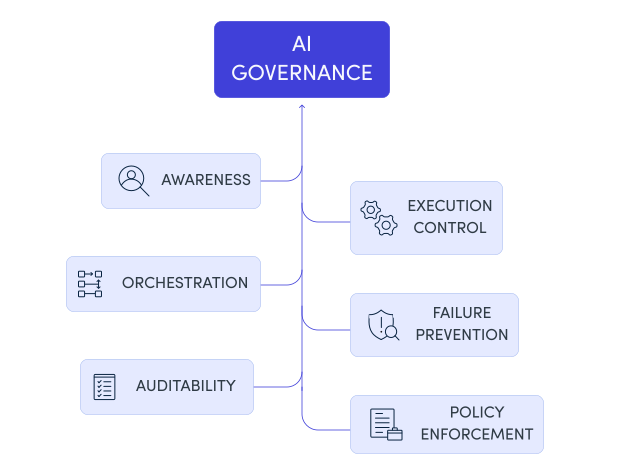
To control AI safely in production, organizations need governance capabilities embedded directly into workflow execution.
Key requirements:
-
Dependency and risk awareness: Understand and manage multi-step AI pipelines across data ingestion, feature engineering, model execution, and downstream systems.
-
Real-time execution control: Enforce policies at runtime (e.g., approvals, thresholds, conditions) before workflows proceed.See runtime enforcement in action in our guide to policy-controlled orchestration.
-
Cross-platform orchestration: Govern workflows consistently across cloud, on-premises, and hybrid environments.
-
Failure prevention and SLA management: Detect and resolve issues before they impact business outcomes.
-
End-to-end auditability: Track what ran, when, why, and under which policy conditions for AI compliance and regulatory reporting.
Capture the full story of every run. Learn how with audit trail and lineage.
-
Policy enforcement at scale: Apply consistent guardrails across hundreds or thousands of pipelines without manual intervention.
One guardrail is easy. Thousands take a plan. Get one with execution guardrails for AI agents.
Why Traditional AI Governance Approaches Fall Short
Without workflow-level orchestration, policies remain theoretical—they can’t be enforced consistently in production.
| Approach | Limitation |
|---|---|
| Model Governance Tools | Limited workflow control; strong only on model quality metrics |
| Data Governance Platforms | Good for lineage and quality, weak on execution control |
| Custom Pipelines / Scripts | Flexible but not scalable or reliably auditable |
| Point Orchestration Tools | Limited cross-platform reach; inconsistent enforcement of policies |
Takeaway: Traditional governance approaches monitor or document AI, but don’t control it in motion or manage risk in real time.
The Business Value of Orchestration-Driven AI Governance in Production AI
Rather than measuring success by individual models, workflow orchestration improves how AI systems operate in production—impacting cost efficiency, operational risk, decision reliability, and scale.
Reduced risk and operational effort
Manual monitoring, restarts, and handoffs create hidden risk at scale. Workflow orchestration automatically manages retries, dependencies, and failures, so teams focus only on exceptions. This reduces friction, prevents cost creep, and keeps AI running smoothly as adoption grows.
Decisions you can trust
Late or misaligned AI outputs can be as harmful as wrong outputs. Workflow orchestration helps ensure AI pipelines run only when inputs are ready and in the correct order.
Faster, more predictable recovery
Pipeline failures happen, but chaos doesn’t have to. Orchestration provides predefined recovery paths and full visibility into dependencies, minimizing downtime, wasted coordination, and the risk of compounding errors.
Control at scale
As AI spreads, workflow orchestration helps ensure consistent execution across teams and systems. By centralizing logs, mapping dependencies, and surfacing exceptions in real time, it gives teams visibility, predictability, and auditability, so growth doesn’t create blind spots or unmanaged risk.
Audit-ready AI workflows
Every workflow execution is recorded—what ran, when, on what data, and how exceptions were handled. This streamlines investigations, strengthens governance, and simplifies audit and regulatory readiness without extra manual tracking.
How Control-M Enables AI Governance in Production
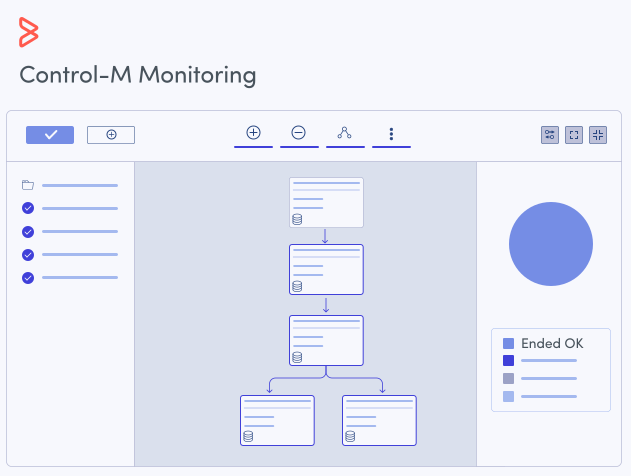
Control-M is a workflow orchestration platform that governs AI at the execution layer—where pipelines run, decisions happen, and risk is realized.
It does this by:
- Orchestrating end-to-end AI workflows - Connect data, models, and business processes into a single controlled pipeline—from ingestion to action.
- Enforcing policies in-line with execution - Build approvals, thresholds, and controls directly into workflows so every run follows governance rules automatically. Stop risky actions before they run. See how with execution guardrails for AI agents.
- Controlling dependencies across systems - Ensure models only run with valid data, in the right sequence, across hybrid and multi-cloud environments.
- Embedding operational guardrails - Trigger validations, human approvals, and exception handling before AI outputs are used. Know exactly when a human should say yes. Read our guide to designing human approval gates.
- Delivering auditability by default - Capture a complete execution record—what ran, when, with what inputs and outcomes—for compliance and risk management. Make every run audit-ready from day one with audit trail and lineage.
Key differentiation: Control-M operates at the execution layer, where real AI risk occurs. It doesn't just monitor models or track lineage. Teams can optionally connect via MCP to enforce policies, manage tool access, and maintain audit trails at the point of execution—enabling enterprise AI guardrails at every step.
High-Value AI Governance Use Cases
AI governance matters most when systems are making decisions, accessing sensitive data or triggering actions which carry real financial, operational, and compliance risk. Organizations moving AI into production need clear controls, visibility, and accountability to ensure outcomes are safe, explainable, and aligned with policy. Some critical use case examples include:
Coordinating Multi-Stage AI Pipelines
Prevent failures across interconnected ML, ETL, and analytics workflows.
SLA-Driven AI Execution
Ensure time-sensitive AI outputs (e.g., fraud detection, pricing) are delivered reliably.
Hybrid AI Workflow Governance
Control AI pipelines across on-prem, cloud, and multi-cloud systems.
Audit-Ready AI Operations
Maintain full traceability for AI compliance, audits, and risk management.
How to Evaluate AI Governance Solutions
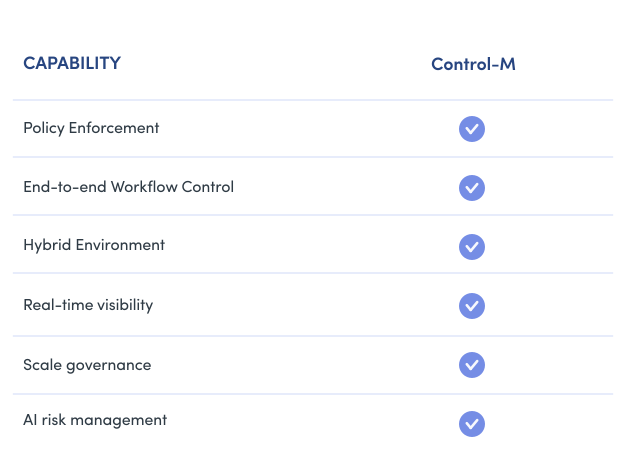
When comparing AI governance platforms or tools, ask:
- Can it enforce policies at runtime—not just define them?
- Does it control end-to-end workflows or only models/data?
- Can it operate across hybrid and multi-cloud environments?
- Does it provide real-time visibility into execution?
- Can it scale governance across hundreds of pipelines?
- Does it integrate AI risk management and compliance tracking?
Takeaway: If the answer is no to any of these, AI risk remains uncontrolled.
AI Governance FAQs for Control-M
Why isn’t model governance alone enough to manage AI risk?

Most AI risk doesn’t come from the model itself—it emerges during execution, when workflows run across multiple systems, dependencies, and environments.
Model and data governance help ensure quality and compliance before deployment, but they don’t prevent pipeline failures, missed outputs, or policy violations in production.
To manage AI risk effectively, governance must extend into live workflows—where decisions are actually executed.
How do I control AI safely in production environments?
How do I make AI workflows audit-ready without adding manual work?
Will adding governance slow down my AI pipelines?
Do I need to replace my existing AI or data tools to implement workflow-level governance?
Do I need to replace my existing AI or data tools to implement workflow-level governance?
AI Governance FAQs for Control-M
Why isn’t model governance alone enough to manage AI risk?
Most AI risk doesn’t come from the model itself—it emerges during execution, when workflows run across multiple systems, dependencies, and environments.
Model and data governance help ensure quality and compliance before deployment, but they don’t prevent pipeline failures, missed outputs, or policy violations in production.
To manage AI risk effectively, governance must extend into live workflows—where decisions are actually executed.
How do I control AI safely in production environments?
How do I make AI workflows audit-ready without adding manual work?
Will adding governance slow down my AI pipelines?
Do I need to replace my existing AI or data tools to implement workflow-level governance?
Do I need to replace my existing AI or data tools to implement workflow-level governance?
Guides for Putting AI Governance into Practice
Execution Guardrails for AI Agents
Set limits on what AI agents can do, before they do it.
Learn more
Audit Trail & Lineage
Track what ran, when, why, and under which policy.
Learn more
Designing Human Approval Gates
Put people in the loop where the risk is highest.
Learn more
Policy-Controlled Orchestration
Enforce governance rules at runtime, on every run.
Learn more
