Let us know how we can help
Sales & Pricing
Speak to a rep about your business needs

Help & Support
See our product support options
General inquiries and locations
Contact us


Keep SAP Financial Close Workflows Moving
Coordinate the SAP and non-SAP job chains behind reconciliations, reporting, and sign-off with visibility into dependencies and exceptions that can delay financial close.

You've automated the close. Why are delays still happening?
Why Close Delays Persist After Automation
You've automated the close, but that doesn't mean every process stays in sync.
A delayed SAP job, data refresh, file transfer, or reporting process can leave downstream activities waiting. More meetings, notifications, and dashboards rarely solve the problem.
Better close performance comes from keeping interconnected SAP and non-SAP workflows moving together and knowing what's affected when a delay occurs.
| Teams often focus on | What improves close performance |
|---|---|
|
More automation |
Coordinated workflow execution |
|
More status meetings |
Early detection of dependency issues |
|
More notifications |
Dependency-aware exception management |
|
More dashboards |
Visibility into workflow status and risk |
Five Signals That Your Close Process Has a Dependency Problem
If your close process is already automated but these issues persist, workflow dependencies may not be fully coordinated or visible, creating hidden bottlenecks.
- You spend hours gathering status updates.
- You learn about delays from downstream stakeholders.
- Close completion dates are difficult to predict.
- Root-cause analysis requires multiple teams.
- Audit evidence must be reconstructed after close.
How Workflow Dependencies Affect Financial Close Execution
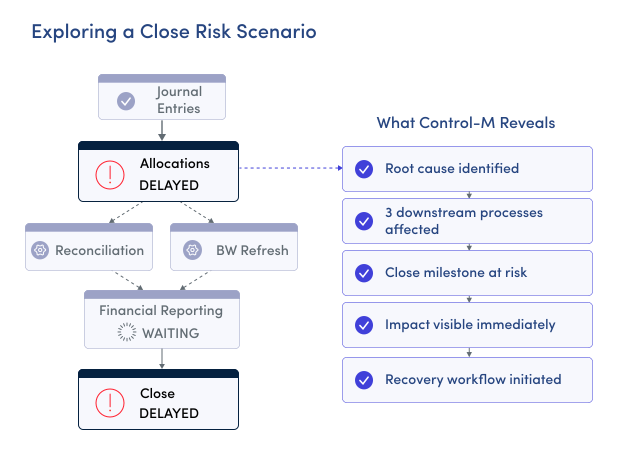
During close, the most important question is "What does that failure affect?"
This example shows how a single delayed allocation run can impact downstream activities and increase risk to close completion. It also shows how Control-M helps you understand downstream impacts across the financial close process.
How Control-M Complements SAP Financial Close Management
If you're using SAP AFC, what role does Control-M play?
SAP Advanced Financial Closing (AFC) helps manage close tasks and milestones. Control-M orchestrates the SAP and non-SAP workflows behind those milestones, keeping dependent processes moving in the right sequence while providing visibility into exceptions, dependencies, and downstream impacts.
Control-M integrates with SAP environments including S/4HANA, ECC, BW, and AFC, while coordinating the data, application, and file-transfer processes that financial close depends on.
| During close, finance teams need to know... | How the need is typically addressed |
|---|---|
|
Have all required close activities been completed? |
SAP AFC provides activity, milestone, and close-process management. |
|
Is account reconciliation waiting on a completed allocation run, data refresh, or file transfer? |
Control-M provides visibility into the SAP jobs, data refreshes, file transfers, reporting workflows, and other technical processes that close activities depend on. |
|
Are close milestones still on track? |
SAP AFC and Control-M provide both process and execution visibility. |
|
Which failed SAP job, delayed data load, or blocked file transfer is putting close completion at risk? |
Control-M helps identify impacted close activities, dependencies, and exceptions. |
|
How are SAP jobs, data refreshes, file transfers, and reporting processes coordinated? |
Control-M orchestrates workflows across SAP and connected environments. |
|
What happened, when, and why? |
Control-M provides execution visibility and traceability across interconnected processes. |
Unlike tools focused primarily on SAP workloads, Control-M provides a single orchestration layer across SAP, data platforms, file transfers, cloud services, and enterprise applications, helping you manage the entire close ecosystem from one place.
What Improves When Workflows Are Orchestrated and Dependencies Are Visible
When you can orchestrate close-critical workflows and monitor dependency status, you’re better equipped to identify issues sooner, recover faster, and improve operational predictability.
| What Gets Better | Why It Matters During Financial Close |
|---|---|
|
Visibility into dependencies |
You can identify what’s running, waiting, blocked, or at risk before delays cascade through the close process. |
|
Predictability of completion |
Earlier awareness of bottlenecks helps you assess whether close milestones remain achievable. |
|
Issue detection |
The faster a dependency issue is identified, the less likely it is to impact downstream activities. |
|
Exception recovery |
Delays become less disruptive when you can understand dependencies and recovery paths. |
|
Auditability |
Close processes increasingly require traceable execution records and controls. |
How Mature Is Your SAP Financial Close Process?
Level 1
Task Visibility
- You know which close activities are complete.
- Teams manually gather status during close.
- Most exception investigation happens through email or meetings.
Level 2
Dependency Visibility
- You understand which allocation runs, reconciliations, data refreshes, reporting processes, and file transfers support major close milestones.
- You can identify downstream impacts when delays occur.
- Finance and operations share execution visibility.
Level 3
Coordinated Execution
- Dependent workflows advance automatically.
- Exceptions are detected quickly.
- Critical-path risks are visible early.
- Close status is based on live execution data.
The Goal Isn't More Automation
You want confidence that close-critical allocations, reconciliations, consolidations, reporting processes, and sign-off activities are progressing as expected. And that starts with keeping close-critical workflows moving in sync and identifying downstream activities that are waiting, blocked, or at risk.
Common Questions About SAP Financial Close Orchestration
Why does financial close still get delayed if we've already automated it?

How can we coordinate close processes that extend beyond SAP?
What can Control-M show us during financial close?
How do we know if a delayed job will affect close completion?
What should we look for in a financial close orchestration solution?
Why does financial close still get delayed if we've already automated it?
How can we coordinate close processes that extend beyond SAP?
What can Control-M show us during financial close?
How do we know if a delayed job will affect close completion?
What should we look for in a financial close orchestration solution?
Keep SAP Financial Close Workflows on Track
See how Control-M helps you coordinate SAP and non-SAP workflows involved in financial close, understand dependency relationships, identify exceptions early, and keep critical close activities moving.