Let us know how we can help
Sales & Pricing
Speak to a rep about your business needs

Help & Support
See our product support options
General inquiries and locations
Contact us


 Control-M + Argo Workflows
Your Argo Workflows run starts before a Kubernetes-native workflow ever executes — and it can fail when something upstream breaks. An S3 input artifact that never lands. A Kubernetes Job that misses its completion window. Control-M orchestrates the full chain: S3 artifact arrival, Spark transformation, Argo Workflow execution, and Snowflake load.
common workflow issues
Does this sound like your week?
These aren’t edge cases. They’re the normal operating conditions for teams running Argo Workflows pipelines across multiple tools. Here’s how Control-M handles each one.
UPSTREAM DEPENDENCIES
Your Argo workflow is ready. The S3 input artifact isn't.
Control-M holds the Argo Workflow until the required upstream delivery completes, then submits the workflow in sequence. Cross-tool dependencies prevent Kubernetes compute from starting against missing inputs and keep the production pipeline moving only when prerequisites are satisfied.
WORKFLOW FAILURE
A workflow failed at 02:14. Downstream processing is still queued.
Control-M monitors workflow status and can automatically retry the Argo Workflow when a failure occurs. Configurable polling and failure tolerance govern detection, while downstream dependencies remain gated until the Argo run reaches the required state.
PARAMETER DRIFT
The workflow started. The production run needs to stay in sequence.
Control-M submits the Argo Workflow as part of the orchestrated job flow, making the workflow run part of the production schedule rather than a manual launch step. Teams can coordinate Argo execution with the upstream jobs and downstream processes that depend on the same production run.
SLA RISK
The DAG is running, but the 06:00 delivery is slipping.
Control-M places the Argo job inside the end-to-end production workflow so its contribution to delivery is tracked within the broader schedule. Operations teams see the workflow in business-process context instead of discovering the delay after downstream consumers are affected.
RECOVERY CONTROL
The workflow needs intervention. Nobody should be editing Kubernetes state manually.
Control-M exposes Argo workflow operations including Hold, Release, Stop, and Terminate, alongside the Retry action. Operators can control recovery through the production orchestration layer while preserving coordination with jobs before and after the Kubernetes workflow.
Control‑M + Argo workflows
Control‑M + Argo workflows
|
workload.types |
Submit Argo Workflow · Monitor Argo Workflow · Kubernetes-native workflows · workflow retry · workflow state operations (Hold · Release · Stop · Terminate) |
|
trigger.type |
advanced scheduling criteria · upstream job completion · Control-M dependency · Control-M variables |
|
cross_tool.deps |
Kubernetes workflows · S3 artifact delivery · Spark processing · Snowflake jobs · database jobs · file transfers · REST API calls |
|
cloud.platforms |
Kubernetes · Amazon EKS · Azure Kubernetes Service · Google Kubernetes Engine · on-premises Kubernetes · any reachable Argo Workflows endpoint |
|
error_handling |
Retry Workflow · configurable failure tolerance · configurable status polling · Hold · Release · Stop · Terminate |
|
throughput |
workflow-level submission · Kubernetes-native workflow execution · configurable status polling · centralized multi-workflow scheduling |
|
observability |
workflow status · results · output · end-to-end dependency visibility · Control-M monitoring |
end-to-end orchestration
One production workflow. Every tool in the stack.
Control-M orchestrates workflows across Argo Workflows, Kubernetes, Spark, Snowflake, file transfers, and cloud services in a single job flow — with dependency tracking, SLA visibility, and automated recovery across all of them.
- Cross-tool dependency: Spark → Argo Workflow → Snowflake → analytics handoff
- Data-aware triggers: file arrival, API event, upstream job completion, workflow result
|
Argo Workflows |
workflow submission · status monitoring · retry · state operations (Hold · Release · Stop · Terminate) |
|
Kubernetes |
containerized workload execution · namespace coordination · workflow infrastructure |
|
Apache Spark |
data processing · transformation jobs · upstream dependency coordination |
|
Snowflake |
data load · SQL execution · downstream analytics dependency |
|
Amazon S3 |
artifact arrival · object delivery · pipeline input coordination |
|
File Transfer |
managed delivery · arrival dependency · downstream handoff |
|
REST APIs |
service invocation · response-driven dependency · application handoff |
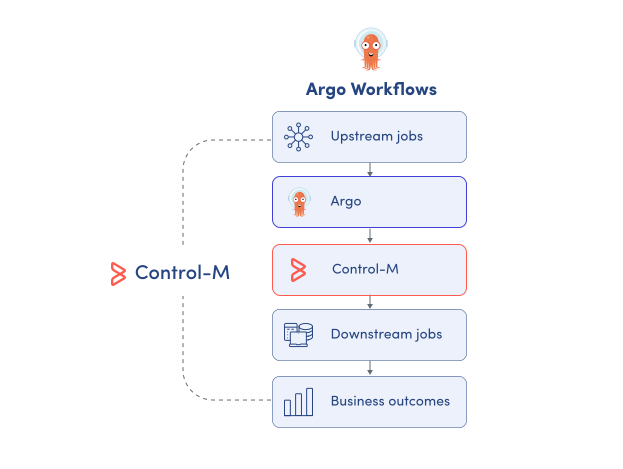
MONITOR PIPELINES
Monitor Argo workflow status, results, and output centrally
Argo shows what is happening inside its Kubernetes workflows; production data pipelines extend beyond that boundary. Control-M provides centralized monitoring of Argo execution alongside the jobs and dependencies surrounding it, giving teams one operational view of:
-
Workflow execution status
-
Results and workflow output
-
Argo node details
-
Upstream and downstream dependencies
-
End-to-end production workflow state
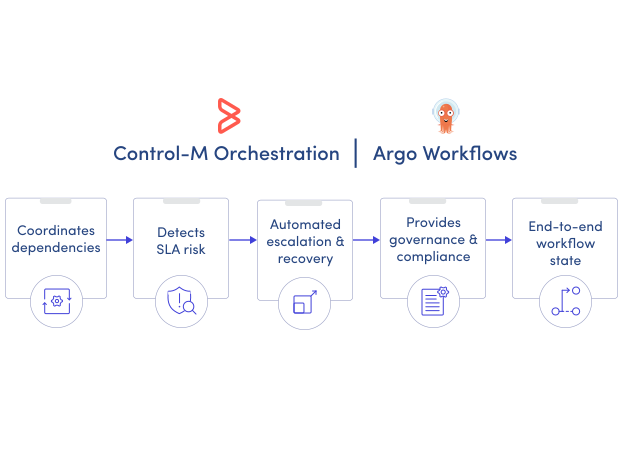
SLA ASSURANCE
Keep Argo pipelines aligned to delivery SLAs
A successful DAG can still contribute to a late business outcome when upstream inputs arrive late or downstream processing stalls. Control-M connects Argo execution to the broader production schedule so teams can manage delivery performance across:
-
End-to-end workflow dependencies
-
Argo execution within the production schedule
-
Advanced scheduling criteria
-
Coordinated failure recovery
-
Downstream workload execution
Documentation
Bring order to complex workflows
Learn how Control-M helps teams orchestrate complex processes with greater visibility, coordination, and control.
