Let us know how we can help
Sales & Pricing
Speak to a rep about your business needs

Help & Support
See our product support options
General inquiries and locations
Contact us


 Control-M + Atlassian Jira
Your Atlassian Jira workflow starts before an issue transition is ever invoked — and it can fail when something upstream breaks. A GitHub release event never arrived. A Jenkins deployment job ran long. Control-M orchestrates the full chain: GitHub event arrival, Jenkins build execution, Jira issue transition, and downstream deployment.
common workflow issues
Does this sound like your week?
These aren’t edge cases. They’re the normal operating conditions for teams running Jira-connected incident, deployment, and operations workflows across multiple tools. Here’s how Control‑M handles each one.
INCIDENT RESPONSE
The PagerDuty alert fired. The Jira ticket never appeared.
Control-M detects monitoring events, evaluates workflow conditions, and automatically creates or updates Jira issues through API-driven actions. Incident workflows start immediately, with ownership, escalation, and recovery tasks launched from a single orchestration layer.
CHANGE CONTROL
Deployment approved in Jira. The release pipeline stayed idle.
Control-M can read a Jira issue state using the Get Issue action, evaluate the result as a dependency condition, and launch downstream deployment jobs only when the required status is confirmed — no manual handoffs, no missed release windows.
FAILURE RECOVERY
The infrastructure job failed at 2:13 AM. Nobody updated Jira
Control-M captures job failures, enriches diagnostic details, and automatically updates Jira tickets with execution status, logs, and remediation context. Teams spend less time gathering evidence and more time resolving issues.
CROSS-TOOL DEPENDENCIES
Jenkins finished. Kubernetes deployed. Jira still shows in progress.
Control-M coordinates status updates across tools, ensuring Jira reflects actual execution states. Workflow completion, failure, rollback, and recovery actions are synchronized automatically across the entire delivery process.
SLA VISIBILITY
The ticket met SLA. The business service still missed it.
Jira tracks issue workflows, but not every dependency contributing to delivery outcomes. Control-M monitors end-to-end execution chains, predicts SLA risk, and alerts teams before upstream delays impact service commitments.
INTEGRATION FACTS
Control‑M + Atlassian Jira
|
API and automation capabilities |
REST API · Jira issue creation · issue field updates · workflow status transitions · Get Transition Details · event-driven orchestration |
|
Deployment models & infrastructure flexibility |
Jira Cloud · Jira Data Center · SaaS · on-premises integration support · hybrid environments · containerized workloads · multi-cloud orchestration |
|
Security posture |
RBAC · PAT authentication (Data Center) · email + Atlassian API Token (Cloud) · Jira Cloud Platform - Service Account · encrypted-in-transit · audit logging · CyberArk vault integration · HashiCorp vault integration |
|
Incident response & MTTR enablement |
automated ticket creation · configurable retry policies · SLA breach alerts · PagerDuty integration · workflow remediation triggers · automated escalation |
end-to-end orchestration
One production workflow. Every tool in the stack.
Control-M orchestrates workflows across Atlassian Jira, Jenkins, Kubernetes, GitHub, Terraform, monitoring platforms, and cloud services in a single job flow — with dependency tracking, SLA visibility, and automated recovery across all of them.
- Cross-tool dependency: GitHub commit → Jenkins build → Kubernetes deployment → Jira update
- Data-aware triggers: webhook event, deployment completion, API response, monitoring alert
|
Atlassian Jira |
issue creation · workflow transitions · ticket updates · approval tracking · incident orchestration |
|
Jenkins |
build execution · pipeline trigger · status monitoring · failure handling |
|
Kubernetes |
deployment automation · rollout validation · workload monitoring · rollback initiation |
|
GitHub |
commit-driven triggers · pull request events · release coordination |
|
AWS CloudFormation |
infrastructure provisioning · stack dependency tracking · environment automation |
|
PagerDuty |
incident escalation · alert synchronization · on-call workflows |
|
AWS / Azure / GCP |
cloud workload orchestration · service coordination · event-driven automation |
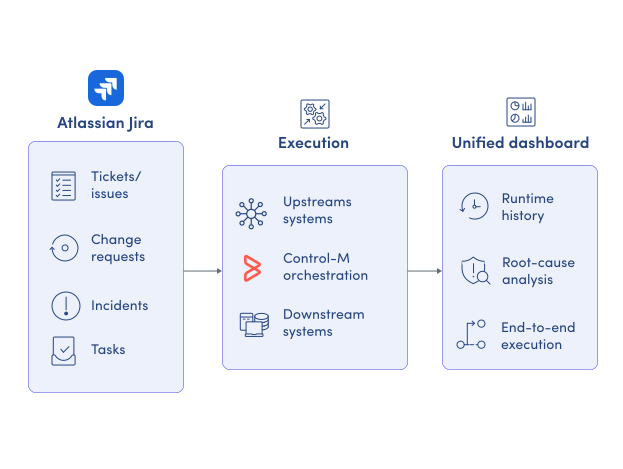
MONITOR WORKFLOWS
Monitor Jira-driven operations in one place.
Jira provides ticket visibility, but not operational visibility across the systems executing the work. Control-M delivers a centralized view of workflow execution, dependencies, failures, and service impacts across the entire delivery chain:
-
End-to-end execution status
-
Cross-platform dependency mapping
-
Runtime and duration history
-
Failure root-cause visibility
-
Unified operational dashboard
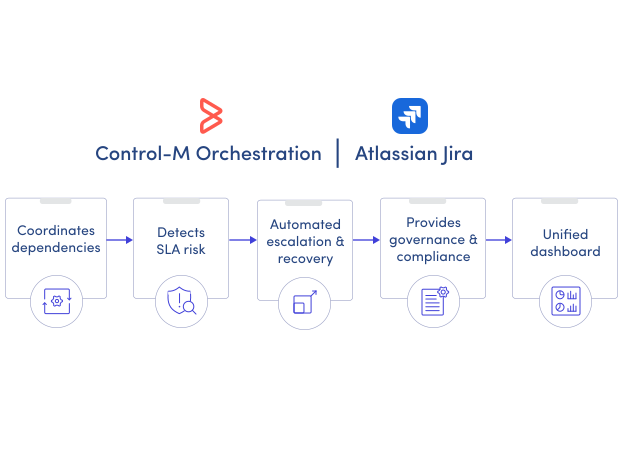
SLA ASSURANCE
Keep Jira workflows aligned with delivery commitments.
Jira can track issue due dates, but it cannot predict workflow delays across infrastructure, deployment, and operational systems. Control-M continuously evaluates execution progress and identifies SLA risk before deadlines are missed:
-
SLA breach prediction
-
Automated escalation workflows
-
Dependency-aware alerting
-
Proactive risk detection
-
Multi-team visibility
Documentation
Bring order to complex workflows
Learn how Control-M helps teams orchestrate complex processes with greater visibility, coordination, and control.
