Let us know how we can help
Sales & Pricing
Speak to a rep about your business needs

Help & Support
See our product support options
General inquiries and locations
Contact us


 Control-M + AWS Auto Scaling Groups
Your AWS Auto Scaling Groups workflow starts before an EC2 instance operation ever executes — and it can fail when something upstream breaks. An Amazon S3 deployment artifact arrives late. An AWS CodeBuild job misses its release window. Control-M orchestrates the full chain: S3 artifact arrival, application build, Auto Scaling Group execution, and deployment validation.
common workflow issues
Does this sound like your week?
These aren’t edge cases. They’re the normal operating conditions for teams running AWS Auto Scaling Group workflows across multiple tools. Here’s how Control-M handles each one.
DEPLOYMENT TIMING
Your build finished at 02:14. The EC2 instances are still stopped.
Control-M detects successful upstream completion, evaluates dependencies, and starts the required EC2 instances in the Auto Scaling Group automatically. Infrastructure activity begins from workflow state instead of a disconnected schedule, eliminating manual handoffs and avoidable deployment delays.
FAILED OPERATIONS
AWS returned 503. Your overnight infrastructure workflow just stalled.
Control-M monitors AWS Auto Scaling Groups job execution and surfaces failures immediately, applying standard Control-M On-Do actions and retry logic so transient issues are handled through the workflow instead of leaving operators to discover and restart stalled infrastructure manually.
INSTANCE CONTROL
Maintenance starts at midnight. The wrong EC2 instances are still running.
Control-M orchestrates AWS Auto Scaling Group operations — create, update, and describe groups and retrieve instance details — as part of the scheduled workflow, coordinating with the Amazon EC2 integration for instance-level start/stop/reboot actions.
CROSS-TOOL DEPENDENCIES
Your application is ready. The infrastructure prerequisite finished forty minutes late.
Control-M places AWS Auto Scaling Groups jobs inside the same workflow as application, data, file-transfer, and cloud jobs. Complex dependencies determine when infrastructure actions can proceed, preventing downstream execution until the required upstream conditions are actually satisfied.
SLA RISK
Every AWS operation succeeded. Your production readiness deadline still slipped.
Individual AWS operations can succeed while the end-to-end workflow still runs late. Control-M attaches SLA management to AWS Auto Scaling Groups jobs and monitors the broader dependency chain, helping operations teams identify schedule risk before a delayed handoff becomes a missed business deadline.
Control‑M + AWS Auto Scaling Groups
Control‑M + AWS Auto Scaling Groups
|
API and automation capabilities |
Control-M Automation API · Job:AWS Auto Scaling Groups · create Auto Scaling Group · update Auto Scaling Group · describe Auto Scaling Group · real-time retrieval of instance ID lists across lifecycle phases · pre- and post-execution steps · conditional logic · REST API configuration |
|
Deployment models & infrastructure flexibility |
Control-M SaaS · Control-M self-managed · Linux Agent · Windows Agent · regional AWS endpoints |
|
Security posture |
AWS IAM authentication · AWS Key & Secret (standard authentication) · centralized connection profile |
|
Incident response & MTTR enablement |
Job status / results / output monitoring · instance ID list retrieval across lifecycle phases · SLA attachment |
end-to-end orchestration
One production workflow. Every tool in the stack.
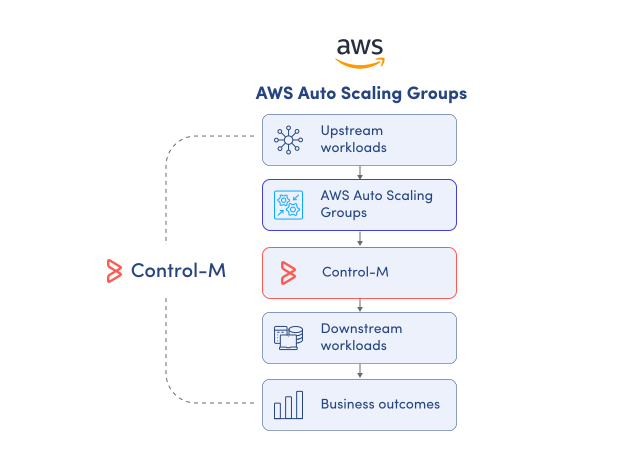
Control-M orchestrates workflows across AWS Auto Scaling Groups, Amazon EC2, AWS CodeBuild, Amazon S3, file transfers, and cloud services in a single job flow — with dependency tracking, SLA visibility, and automated recovery across all of them.
- Cross-tool dependency: AWS CodeBuild → AWS Auto Scaling Groups → EC2 instance operation → application validation
- Data-aware triggers: file arrival, API event, build completion, upstream job completion
|
AWS Auto Scaling Groups |
create groups · update groups · describe groups · instance ID list retrieval · status monitoring |
|
Amazon EC2 |
instance coordination · start/stop/reboot/terminate · infrastructure dependency management |
|
AWS CodeBuild |
build orchestration · completion dependencies · downstream infrastructure handoff |
|
Amazon S3 |
object arrival dependency · workflow triggering · downstream coordination |
|
AWS Lambda |
function execution · workflow dependencies · downstream processing |
|
File transfers |
managed transfer · arrival detection · delivery dependencies |
|
Control-M |
scheduling · complex dependencies · resource pools · lock resources · variables · SLA management |
MONITOR INFRASTRUCTURE
Monitor AWS Auto Scaling Group operations end to end.
AWS exposes infrastructure state, but production workflows extend beyond a single scaling group or EC2 operation. Control-M centralizes AWS Auto Scaling Groups jobs with their upstream and downstream dependencies, giving platform teams one operational view of execution:
-
Job execution status
-
Results and output monitoring
-
Cross-platform dependency visibility
-
Infrastructure workflow history
-
End-to-end SLA context
SLA ASSURANCE
Keep infrastructure workflows aligned with production deadlines.
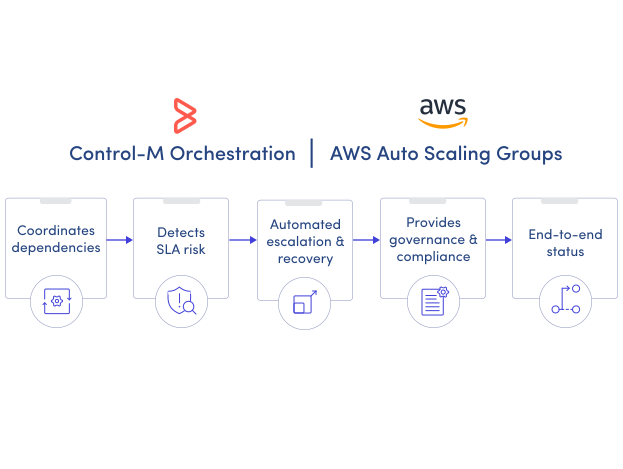
AWS can report an infrastructure operation as successful without knowing whether the complete production workflow will finish on time. Control-M adds end-to-end SLA management, dependency-aware scheduling, and automated failure handling across the surrounding workflow:
-
End-to-end SLA tracking
-
Complex dependency management
-
Configurable failure reruns
-
Verification polling controls
-
Coordinated downstream execution
Documentation
Bring order to complex workflows
Learn how Control-M helps teams orchestrate complex processes with greater visibility, coordination, and control.
