Let us know how we can help
Sales & Pricing
Speak to a rep about your business needs

Help & Support
See our product support options
General inquiries and locations
Contact us


 Control-M + Amazon SQS
Your Amazon SQS workflow starts before a message-send job ever runs — and it can fail when something upstream breaks. An Amazon S3 object never arrives. An AWS Lambda transformation finishes late. Control-M orchestrates the full chain: S3 object arrival, Lambda transformation, SQS message send, and ECS consumer processing.
common workflow issues
Does this sound like your week?
These aren’t edge cases. They’re the normal operating conditions for teams running Amazon SQS workflows across multiple tools. Here’s how Control‑M handles each one.
UPSTREAM FAILURE
Your Lambda failed. The SQS message must not go out.
Control-M detects the upstream job state and prevents the dependent Amazon SQS job from executing. The message is sent only after required workflow conditions succeed, keeping downstream consumers from acting on incomplete or failed processing.
LATE DEPENDENCY
The 02:00 S3 delivery is late. Your queue workflow is waiting.
Control-M tracks the upstream dependency instead of relying on a fixed cron window. The Amazon SQS job waits for the required workflow condition, while SLA monitoring gives operations teams visibility into delay and downstream business impact.
FIFO ORDERING
Your FIFO workflow needs the right message group and deduplication ID.
Control-M Amazon SQS jobs support FIFO queue parameters including Message Group ID and Message Deduplication ID. Teams can define these alongside the message body and attributes while coordinating the send with the surrounding production workflow.
CROSS-ACCOUNT ACCESS
The target queue sits in another AWS account. Credentials become the blocker.
Control-M supports AWS Assume Role authentication for cross-account access, alongside AWS IAM Role and access key authentication. Centralized connection profiles separate authorization details from job definitions, simplifying secure execution across AWS account boundaries.
SLA RISK
The message was sent. The end-to-end workflow is still running late.
Control-M monitors the Amazon SQS job alongside upstream and downstream jobs and can attach an SLA job to the workflow. Teams see status, results, output, dependencies, and schedule risk without treating the queue operation as an isolated event.
INTEGRATION FACTS
Control‑M + Amazon SQS
|
API and automation capabilities |
Control-M Automation API · Amazon SQS job definitions · preset message sending · manual JSON message structures · Standard queues · FIFO queues · message attributes · variables |
|
Deployment models & infrastructure flexibility |
Control-M SaaS · self-managed Control-M · Control-M Web · Automation API · Linux Agent · Windows Agent · regional Amazon SQS endpoints |
|
Security posture |
centralized connection profiles · AWS Key & Secret · AWS IAM Role · AWS Assume Role · cross-account authentication · external vault integration · IAM-based AWS access |
|
Incident response & MTTR enablement |
job status monitoring · results and output monitoring · complex dependencies · downstream execution control · SLA jobs · advanced scheduling criteria · resource pools · lock resources |
end-to-end orchestration
One production workflow. Every tool in the stack.
Control-M orchestrates workflows across Amazon SQS, Amazon S3, AWS Lambda, AWS Step Functions, Amazon ECS, and cloud services in a single job flow — with dependency tracking, SLA visibility, and automated recovery across all of them.
- Cross-tool dependency: S3 arrival → Lambda transformation → Amazon SQS message → ECS processing
- Data-aware triggers: file arrival, API event, upstream job completion, application result
|
Amazon SQS |
message sending · Standard queues · FIFO queues · message attributes · job monitoring |
|
Amazon S3 |
object workflows · upstream dependencies · downstream triggering |
|
AWS Lambda |
function execution · dependency coordination · status monitoring |
|
AWS Step Functions |
state machine execution · workflow dependencies · status monitoring |
|
Amazon ECS |
container workload execution · dependency coordination · scheduling |
|
Control-M |
scheduling · cross-tool dependencies · SLA management · monitoring · recovery |
MONITOR WORKFLOWS
See Amazon SQS jobs in workflow context
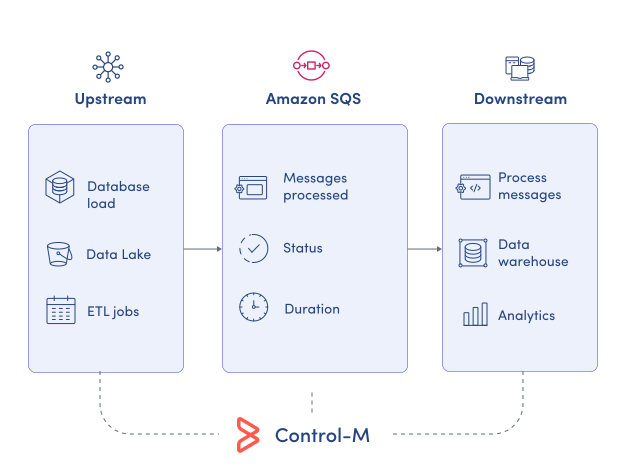
Amazon SQS provides queue-level service visibility, but an SQS operation can be only one step in a larger production process. Control-M brings its execution into the same operational view as the jobs that run before and after it:
-
Amazon SQS job status
-
Job results and output
-
Upstream and downstream dependencies
-
End-to-end workflow visibility
-
SLA status and risk
SLA ASSURANCE
Manage the SLA beyond the Amazon SQS send
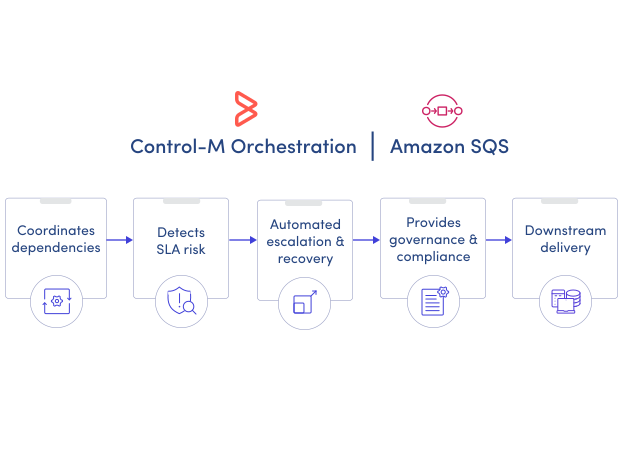
A successful message send does not prove the business workflow finished on time. Control-M connects Amazon SQS execution to the SLA of the complete process, helping teams identify upstream delays and coordinate dependent jobs before deadlines are missed:
-
Attach SLA jobs
-
Track cross-service dependencies
-
Control downstream execution
-
Monitor job results
-
Coordinate failure recovery
Documentation
Bring order to complex workflows
Learn how Control-M helps teams orchestrate complex processes with greater visibility, coordination, and control.
