Let us know how we can help
Sales & Pricing
Speak to a rep about your business needs

Help & Support
See our product support options
General inquiries and locations
Contact us


 Control-M + AWS
Your Amazon EC2 workflow starts before a virtual machine instance ever runs its workload — and it can fail when something upstream breaks. An Amazon S3 input dataset never lands in the processing bucket before the instance's launch window. An AWS CodeDeploy deployment overruns its installation timeout before the target instance is ready to process. Control-M orchestrates the full chain: Amazon S3 data landing, AWS CodeDeploy application staging, Amazon EC2 execution, and Amazon Redshift delivery.
common workflow issues
Does this sound like your week?
These aren’t edge cases. They’re the normal operating conditions for teams running AWS DataSync transfers across multiple tools. Here’s how Control‑M handles each one.
UPSTREAM DEPENDENCIES
The S3 file never arrived. Your Lambda never should have started.
Control-M waits for verified upstream events—not assumptions. It monitors file arrivals, API responses, database updates, and external job completion before triggering AWS workloads, preventing downstream failures, unnecessary compute costs, and manual intervention.
FAILED RECOVERY
AWS Batch failed at 2:17 AM. Nobody noticed until business opened.
Control-M detects failed AWS jobs immediately, applies configurable retries and recovery policies, alerts the right teams through tools like PagerDuty or Slack, and prevents dependent workflows from continuing until recovery conditions are satisfied.
CROSS-SERVICE FLOWS
Step Functions finished. The downstream SAP process never started.
Cloud-native workflows rarely end inside AWS. Control-M coordinates dependencies across AWS services, enterprise applications, databases, file transfers, and third-party platforms, ensuring every downstream process starts automatically when upstream conditions are met.
SLA VISIBILITY
Everything is running. You still can't tell if you'll hit your SLA.
Control-M provides end-to-end workflow visibility with predictive SLA monitoring, critical path tracking, and dependency awareness across hybrid environments, allowing teams to identify delivery risks before service levels are breached.
AUTOMATION SPRAWL
Lambda. EventBridge. Cron. Scripts. Nobody owns the complete workflow.
Control-M unifies fragmented automation into a single orchestrated workflow. Instead of managing isolated schedules and service-specific triggers, teams gain centralized control, governance, auditing, and observability across AWS services and the surrounding enterprise ecosystem.
Control‑M + AWS
Control‑M + AWS
|
API and automation capabilities |
REST API · Control-M Automation API · AWS Lambda invocation · Amazon EventBridge events · AWS Step Functions orchestration · CLI support |
|
Deployment models & infrastructure flexibility |
AWS cloud · hybrid cloud · multi-cloud · on-premises integration · containerized workloads (Amazon ECS · Amazon EKS via Control-M for Kubernetes)) · Amazon EC2 · Control-M SaaS or self-hosted deployment |
|
Security posture |
AWS IAM integration · role-based access control (RBAC) · SAML/SSO · encrypted in transit · encrypted at rest · AWS Secrets Manager integration · audit logging |
|
Incident response & MTTR enablement |
Configurable retries with backoff · automated recovery workflows · downstream dependency protection · SLA breach prediction · PagerDuty and Slack notifications |
end-to-end orchestration
One production workflow. Every tool in the stack.
Control-M orchestrates workflows across AWS services, Kubernetes, databases, file transfers, CI/CD pipelines, enterprise applications, and cloud platforms in a single job flow—with dependency tracking, SLA visibility, and automated recovery across all of them.
- Cross-tool dependency: S3 file arrival → AWS Lambda → AWS Step Functions → Amazon ECS batch workload → SAP update → ServiceNow notification
- Data-aware triggers: S3 object creation · EventBridge event · API request · Lambda completion · Step Functions completion · file arrival · upstream job exit status
|
AWS Lambda |
Invoke functions · monitor execution status · capture exit conditions · orchestrate downstream workflows |
|
Amazon S3 |
Monitor file arrivals · validate objects · trigger workflows · manage event-driven dependencies |
|
AWS Step Functions |
Trigger state machines · monitor completion · coordinate downstream enterprise processes · automate recovery |
|
Amazon ECS / EKS |
Launch container workloads · manage dependencies · monitor execution · orchestrate hybrid workflows |
|
Jenkins |
Trigger CI/CD pipelines · monitor build status · synchronize deployments with operational workflows |
|
ServiceNow |
Create incidents · trigger change workflows · update tickets automatically · synchronize operational events |
|
SAP |
Coordinate business process execution · manage cross-platform dependencies · trigger ERP jobs following AWS workflow completion |
airflow coexistance
Control‑M doesn’t replace your Airflow DAGs. It runs the layer above them.
The objection is common: “We’re already on Airflow.” The issue isn’t what Airflow does –it’s what happens before and after Airflow runs. That’s where pipelines actually fail.
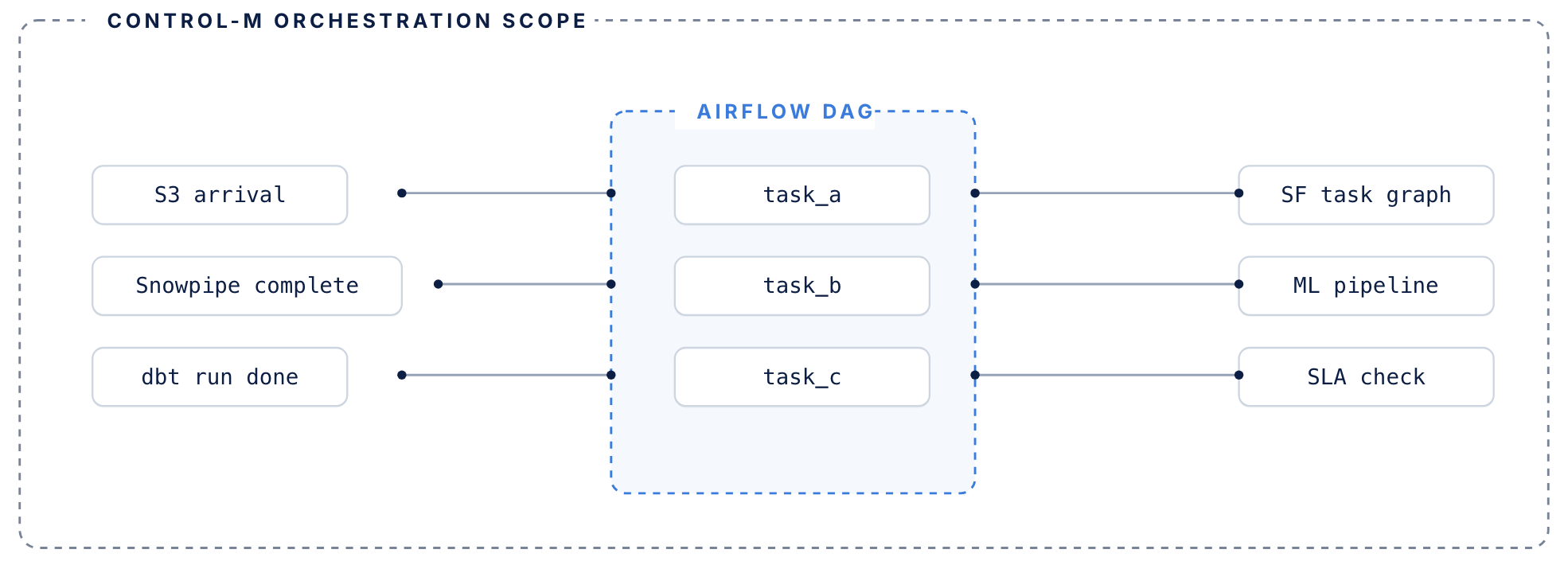
Airflow manages its DAG. Control-M manages everything surrounding it.
airflow handles
DAG-level orchestration inside the data pipeline
- DAG-level task orchestration within data pipelines
- Python operators, sensors, and task dependencies
- Execution graphs for jobs that run inside your pipeline
- Manages retries within a single DAG context
control-m adds
The coordination layer around your DAGs
- Coordination layer around DAGs — triggers Airflow based on upstream conditions: file arrivals, API events, other tool completions
- Tracks each DAG’s SLA contribution across the full end-to-end workflow, not just its own routine
- Manages failure recovery when upstream dependencies fail before Airflow even starts
- Existing DAGs don’t need to be rewritten or migrated
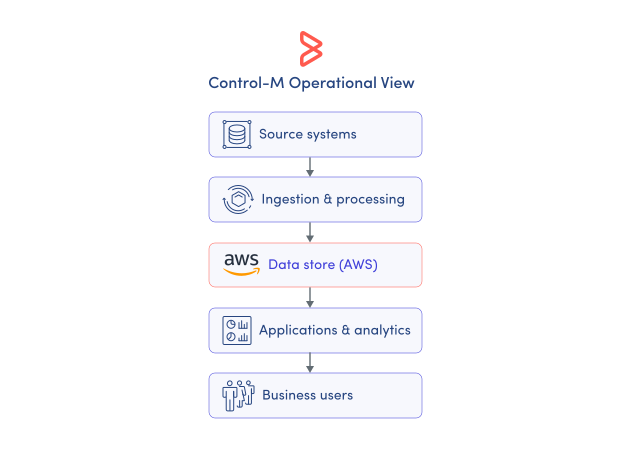
MONITOR WORKFLOWS
Monitor AWS workflows from a single operational view.
AWS provides visibility into individual services, but not the complete business workflow spanning cloud services, enterprise applications, and external platforms. Control-M delivers centralized monitoring, dependency awareness, and operational intelligence across every workflow from start to finish:
-
End-to-end workflow visibility
-
• Cross-service dependency mapping
-
Runtime and execution history
-
Predictive SLA monitoring
-
Unified operational dashboard
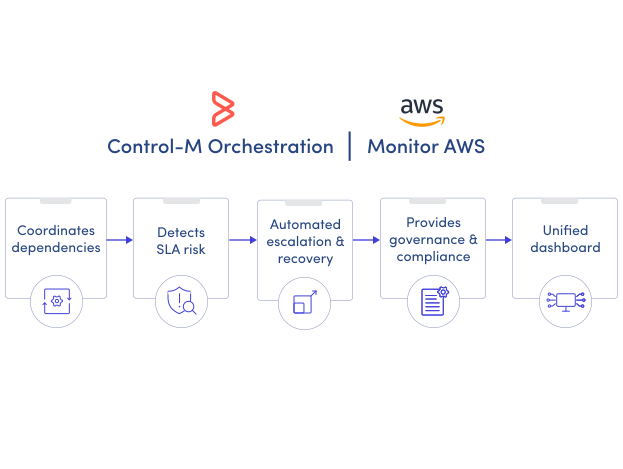
AUTOMATED RECOVERY
Recover AWS failures before they become business outages.
Native AWS services can retry individual tasks, but they don't coordinate recovery across the entire production workflow. Control-M automatically manages retries, applies recovery policies, protects downstream systems, and alerts responders when intervention is required:
-
Configurable retry policies
-
Automated workflow recovery
-
Downstream cascade prevention
-
PagerDuty and Slack alerts
Documentation
Bring order to complex workflows
Learn how Control-M helps teams orchestrate complex processes with greater visibility, coordination, and control.
