Let us know how we can help
Sales & Pricing
Speak to a rep about your business needs

Help & Support
See our product support options
General inquiries and locations
Contact us


 Control-M + Azure Machine Learning
Your Azure Machine Learning workflow starts before an endpoint pipeline ever executes — and it can fail when something upstream breaks. An Azure Blob Storage input didn’t arrive. An Azure Data Factory pipeline ran long. Control-M orchestrates the full chain: Azure Blob data arrival, Azure Data Factory transformation, Azure Machine Learning execution, and downstream delivery.
common workflow issues
Does this sound like your week?
UPSTREAM DATA
Your training run is due. Azure Blob data still hasn’t arrived.
Control-M keeps the Azure Machine Learning job dependent on the upstream workflow instead of a standalone time schedule. Execution starts only after required processing completes, keeping late data from becoming an incorrectly timed machine learning run.
ADF · AZURE ML
Your Data Factory pipeline finished. The machine learning job is still waiting.
Control-M coordinates Azure Data Factory and Azure Machine Learning jobs within the same scheduling environment, using job dependencies to release execution after upstream processing completes — eliminating disconnected schedules and manual handoffs between pipeline stages.
FAILURE RECOVERY
The pipeline job failed overnight. Everything downstream is still dependent on it.
Control-M tracks Azure Machine Learning job status and applies workflow conditions around the result, preventing dependent processing from continuing after a failed execution. Teams can recover the failed stage without blindly advancing the downstream workflow.
COMPUTE MANAGEMENT
Training is finished. The Azure ML compute cluster is still running.
Control-M can coordinate Azure Machine Learning compute management with the production workflow, including start, stop, restart, and delete actions. Compute lifecycle becomes another orchestrated step rather than a disconnected operational task after model processing finishes.
SLA RISK
The ML job is running long. Your morning delivery window is closing.
Control-M brings the Azure Machine Learning job into the end-to-end SLA workflow, so teams can see its impact on dependent processing and delivery deadlines instead of monitoring the ML execution independently from the business service.
Control‑M + Azure Machine Learning
Control‑M + Azure Machine Learning
|
workload.types |
endpoint pipeline execution · existing job execution · compute management · compute start · compute stop · compute restart · compute delete |
|
trigger.type |
time schedule · upstream job completion · Control-M dependencies · file arrival workflow · API-driven execution · Automation API |
|
cross_tool.deps |
Azure Data Factory pipeline · Azure Blob Storage arrival · Azure Databricks job · Apache Airflow DAG · REST API call · downstream analytics |
|
cloud.platforms |
Microsoft Azure · Azure Machine Learning workspace · Azure compute · Control-M SaaS · hybrid Control-M environment |
|
error_handling |
failure tolerance · status polling frequency · Control-M job conditions · downstream cascade prevention · workflow recovery · SLA monitoring |
|
throughput |
asynchronous ML execution · long-running pipelines · batch inference workflows · compute-cluster processing |
|
observability |
job status · job results · job output · dependency visibility · SLA tracking · centralized workflow monitoring |
end-to-end orchestration
One production workflow. Every tool in the stack.
Control-M orchestrates workflows across Azure Machine Learning, Azure Data Factory, Azure Blob Storage, Azure Databricks, Airflow, file transfers, and cloud services in a single job flow — with dependency tracking, SLA visibility, and automated recovery across all of them.
- Cross-tool dependency: Azure Data Factory → Azure Machine Learning pipeline → Azure Databricks → analytics handoff
- Data-aware triggers: file arrival, API event, upstream job completion, pipeline completion
|
Azure Machine Learning |
pipeline execution · existing-job execution · compute management · status monitoring |
|
Azure Data Factory |
pipeline execution · completion dependencies · workflow handoff |
|
Azure Blob Storage |
file arrival · data dependencies · downstream release |
|
Azure Databricks |
job execution · dependency coordination · downstream processing |
|
Apache Airflow |
DAG execution · status tracking · workflow dependencies |
|
File transfers |
data movement · arrival detection · workflow release |
|
Analytics services |
downstream handoff · scheduled delivery · dependency coordination |
airflow coexistance
Control-M doesn’t replace your Airflow DAGs. It runs the layer above them.
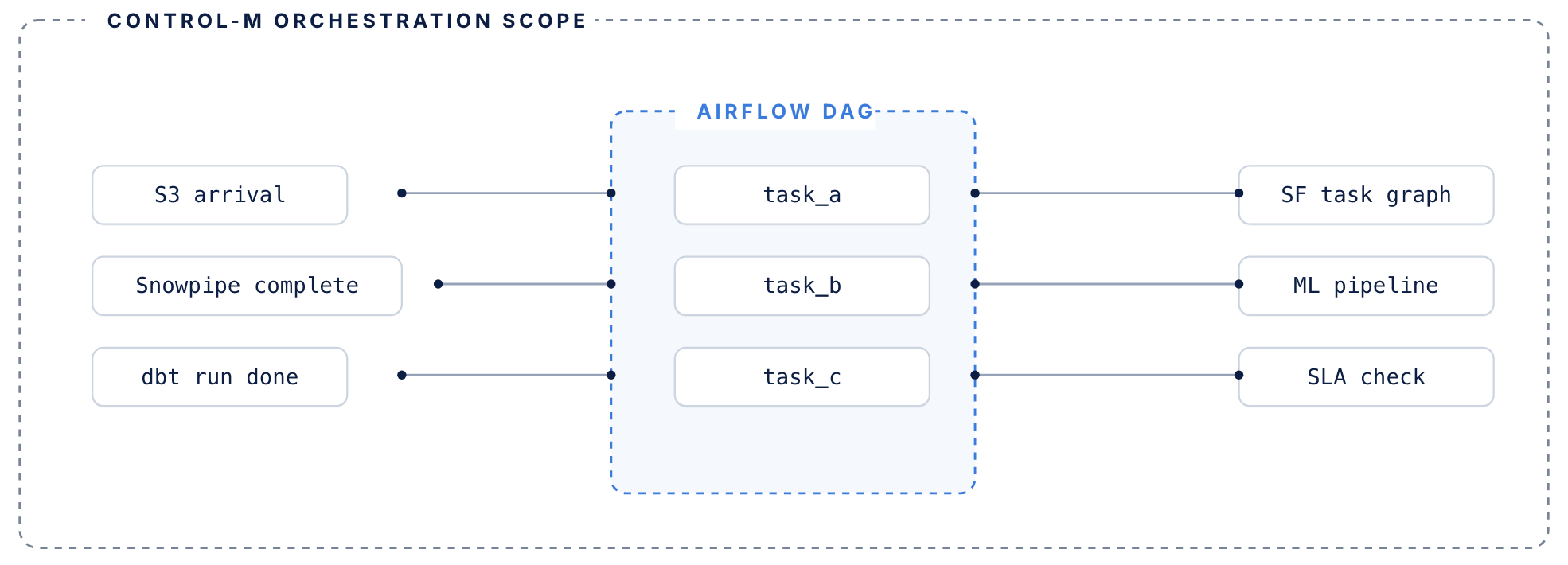
Airflow manages its DAG. Control-M manages everything surrounding it.
AIRFLOW HANDLES
DAG-level orchestration inside the data pipeline
- DAG-level task orchestration within data pipelines
- Python operators, sensors, and task dependencies
- Execution graph for jobs that run inside your pipeline
- Manages retries within a single DAG context
control-m adds
The coordination layer around your DAGs
- Coordination layer around DAGs — triggers Airflow based on upstream conditions: file arrivals, API events, other tool completions
- Tracks each DAG’s SLA contribution across the full end-to-end workflow, not just its own routine
- Manages failure recovery when upstream dependencies fail before Airflow even starts
- Existing DAGs don’t need to be rewritten or migrated
MONITOR ML JOBS
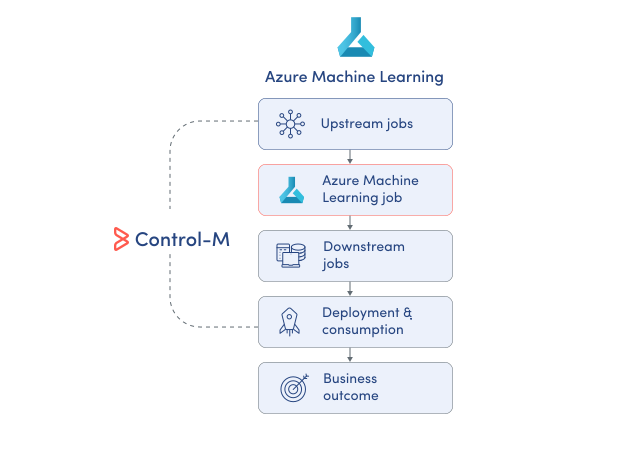
Monitor Azure Machine Learning jobs across the pipeline
Azure Machine Learning shows execution within its own environment. Control-M connects that execution to the wider production pipeline, giving DataOps teams a centralized view of ML jobs alongside the upstream and downstream workloads that determine successful delivery:
-
Azure ML job status
-
Job results and output
-
Upstream and downstream dependencies
-
End-to-end workflow visibility
-
Cross-platform execution status
SLA ASSURANCE
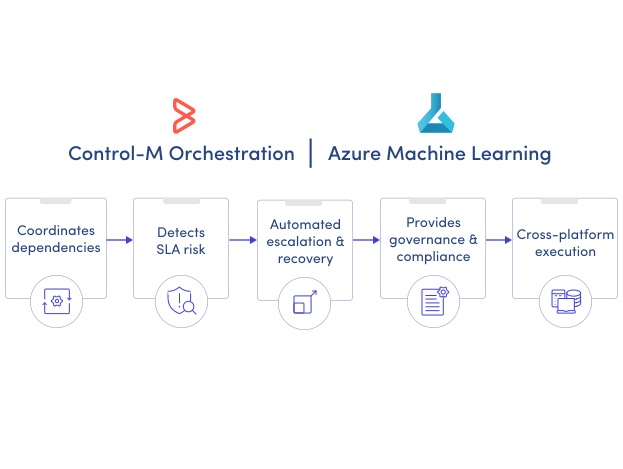
Keep machine learning pipelines aligned to delivery SLAs
Azure Machine Learning can tell you how an ML job is executing. Control-M shows how that job affects the deadline for the complete production workflow, connecting ML execution with upstream dependencies, downstream processing, and service-level delivery:
-
End-to-end SLA monitoring
-
Cross-platform dependency visibility
-
ML job status monitoring
-
Downstream delivery coordination
-
Centralized workflow control
