Let us know how we can help
Sales & Pricing
Speak to a rep about your business needs

Help & Support
See our product support options
General inquiries and locations
Contact us


 Control-M + Azure Synapse
Your Azure Synapse workflow starts before a pipeline ever executes — and it can fail when something upstream breaks. An Azure Data Lake Storage Gen2 landing file arrives incomplete. An Azure Databricks transformation finishes after its expected window. Control-M orchestrates the full chain: ADLS Gen2 data arrival, Databricks transformation, Azure Synapse pipeline execution, and downstream Power BI delivery.
common workflow issues
Does this sound like your week?
These aren’t edge cases. They’re the normal operating conditions for teams running Azure Synapse pipelines across multiple tools. Here’s how Control-M handles each one.
LATE DATA ARRIVAL
ADLS Gen2 data lands late. Your 2 a.m. Synapse pipeline must wait.
Control-M coordinates file-arrival conditions with the Azure Synapse job, so execution waits for the required upstream data instead of relying on a fixed clock. The pipeline starts only after its prerequisite is satisfied, reducing premature runs and manual intervention.
PIPELINE FAILURE
A notebook activity fails after 40 minutes. Downstream delivery must stop.
Control-M monitors the Azure Synapse job status, results, and output. When the pipeline returns a failure, downstream dependencies remain blocked instead of cascading bad or incomplete data into reporting, analytics, or other production processes.
ABORT RECOVERY
The parent pipeline is aborted. Its child pipelines are still running.
Control-M for Azure Synapse supports recursive abort of child pipelines during a manual abort. Operators can stop the affected execution chain instead of leaving child pipelines consuming resources or producing outputs after the parent workflow has been terminated.
RESOURCE CONTENTION
Synapse demand peaks at 6 a.m. Too many pipelines launch together.
Control-M resource pools can gate concurrent job execution around constrained logical resources, while scheduling criteria coordinate when work becomes eligible to run. Teams control workload pressure without embedding another layer of timing logic inside every Synapse pipeline.
BROKEN HANDOFF
The Synapse pipeline succeeded. The downstream Power BI refresh never started.
Control-M evaluates the successful Synapse job completion as part of the broader workflow and releases the next dependent job automatically. The handoff becomes an explicit managed dependency rather than a cron window, polling script, or manual trigger.
INTEGRATION FACTS
Control‑M + Azure Synapse
|
workload.types |
Azure Synapse pipeline execution · parameterized pipeline runs · child pipeline orchestration · recursive child-pipeline abort |
|
trigger.type |
time schedule · calendar criteria · upstream job completion · Control-M event · file arrival prerequisite · API-driven order · manual order |
|
cross_tool.deps |
Azure Data Factory pipeline · Azure Databricks job · Apache Airflow DAG · Power BI refresh · REST API call · file transfer completion · upstream job exit status |
|
cloud.platforms |
Microsoft Azure · hybrid cloud · Control-M SaaS · Control-M Self-Hosted |
|
error_handling |
job status detection · configurable Control-M rerun logic · downstream cascade prevention · manual recursive child-pipeline abort · resource controls · SLA alerting |
|
throughput |
50 simultaneous Azure Synapse jobs per Agent · concurrent pipeline execution · resource-pool controlled concurrency · parameterized pipeline runs |
|
observability |
job status · results · output · Control-M Monitoring domain · end-to-end dependency visibility · SLA tracking · centralized job monitoring |
end-to-end orchestration
One production workflow. Every tool in the stack.
Control-M orchestrates workflows across Azure Synapse, Azure Data Lake Storage Gen2, Azure Databricks, Apache Airflow, Power BI, file transfers, and cloud services in a single job flow — with dependency tracking, SLA visibility, and automated recovery across all of them.
- Cross-tool dependency: Azure Databricks → Azure Synapse pipeline → Power BI refresh → analytics handoff
- Data-aware triggers: file arrival, API event, upstream job completion, pipeline completion
|
Azure Synapse |
pipeline execution · parameter overrides · status monitoring · results and output · SLA coordination |
|
Azure Data Lake Storage Gen2 |
file-arrival coordination · upstream data dependency · workflow initiation |
|
Azure Databricks |
job execution · notebook orchestration · completion dependency · status monitoring |
|
Apache Airflow |
DAG execution · status tracking · cross-workflow dependency · SLA coordination |
|
Microsoft Power BI |
data refresh · pipeline deployment · downstream dependency · status monitoring |
|
File transfers |
managed delivery · arrival dependency · downstream workflow initiation |
|
REST APIs |
API-driven workflow integration · external system coordination · automated handoffs |
airflow coexistance
Control‑M doesn’t replace your Airflow DAGs. It runs the layer above them.
The objection is common: “we’re already on Airflow.” The issue isn’t what Airflow does – it’s what happens before and after Airflow runs. That’s where pipelines actually fail.
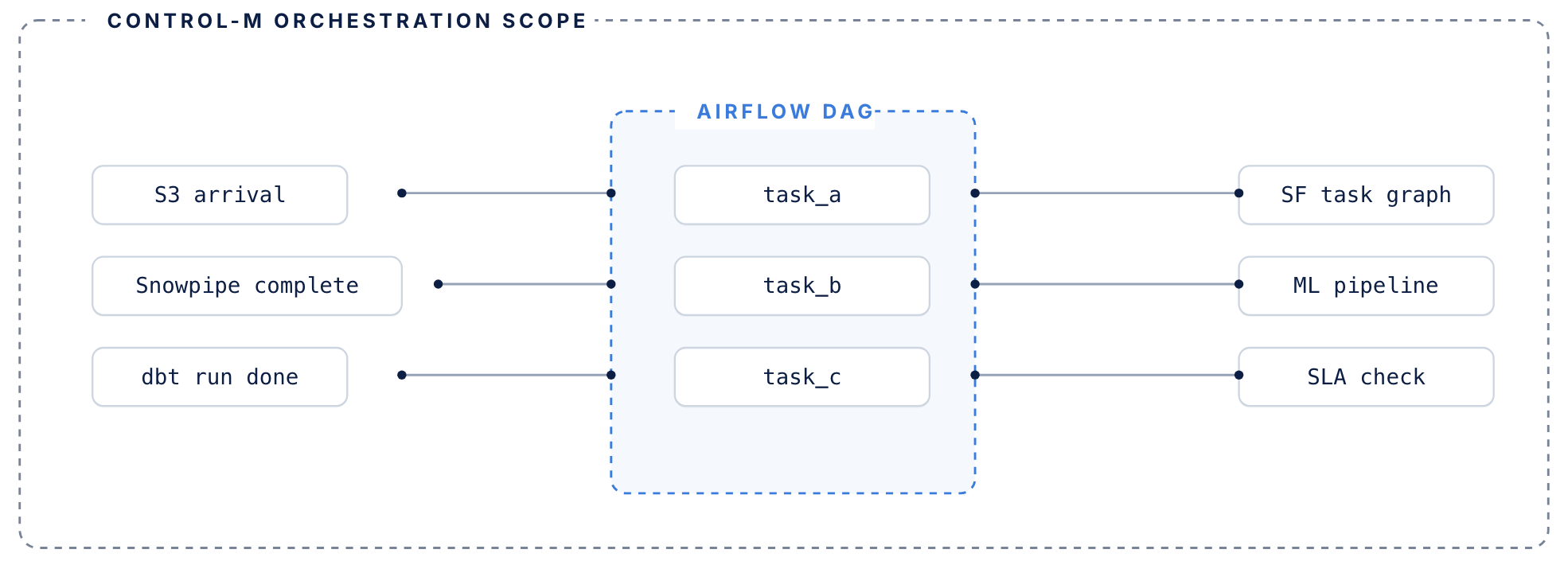
Airflow manages its DAG. Control-M manages everything surrounding it.
AIRFLOW HANDLES
DAG-level orchestration inside the data pipeline
- DAG-level task orchestration within data pipelines
- Python operators, sensors, and task dependencies
- Execution graph for jobs that run inside your pipeline
- Manages retries within a single DAG context
CONTROL-M ADDS
The coordination layer around your DAGs
- Coordination layer around DAGs — triggers Airflow based on upstream conditions: file arrivals, API events, other tool completions
- Tracks each DAG’s SLA contribution across the full end-to-end workflow, not just its own routine
- Manages failure recovery when upstream dependencies fail before Airflow even starts
- Existing DAGs don’t need to be rewritten or migrated
MONITOR PIPELINES
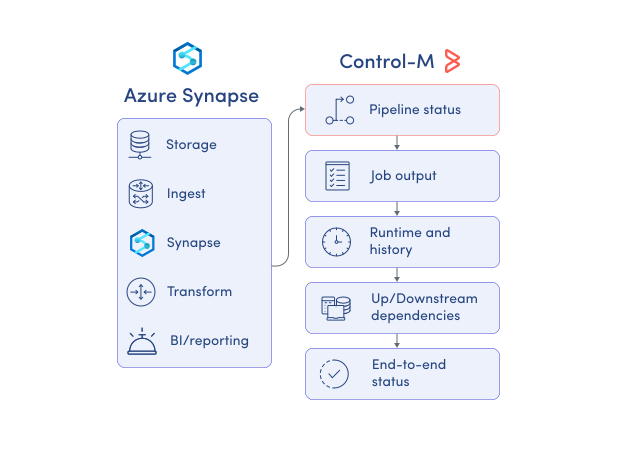
Monitor Azure Synapse execution across the entire workflow.
Azure Synapse provides visibility into its pipeline runs, but production data flows often extend across storage, transformation, orchestration, and BI platforms. Control-M provides centralized monitoring of Synapse jobs and their surrounding dependencies so teams can see execution in context:
-
Pipeline execution status
-
Job results and output
-
Runtime and execution history
-
Upstream and downstream dependencies
-
End-to-end workflow status
SLA ASSURANCE
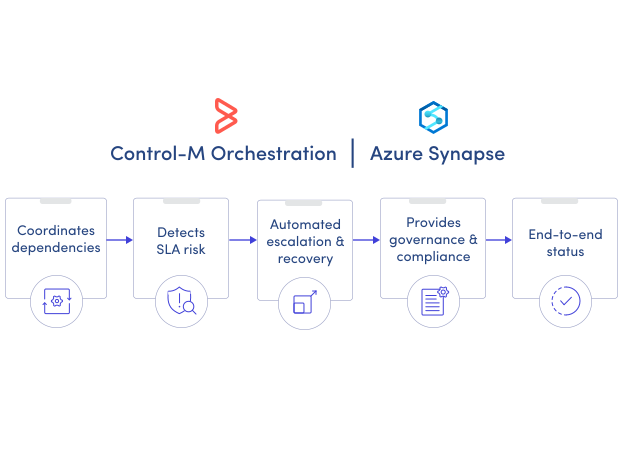
Keep Azure Synapse pipelines on schedule.
A Synapse pipeline can finish successfully and still contribute to a missed business deadline when upstream data arrives late or downstream processing stalls. Control-M manages the service across the full job chain, giving teams earlier visibility into delivery risk:
-
End-to-end SLA tracking
-
Service completion-time visibility
-
Dependency-aware status monitoring
-
Resource-aware job coordination
-
Automated downstream gating
Documentation
Bring order to complex workflows
Learn how Control-M helps teams orchestrate complex processes with greater visibility, coordination, and control.
