Let us know how we can help
Sales & Pricing
Speak to a rep about your business needs

Help & Support
See our product support options
General inquiries and locations
Contact us


 Control-M + GCP Deployment Manager
Your GCP Deployment Manager workflow starts before a deployment configuration ever executes — and it can fail when something upstream breaks. A Cloud Storage configuration artifact arrives late. A GitHub Actions validation workflow fails minutes before the deployment window. Control-M orchestrates the full chain: configuration arrival, CI validation, GCP Deployment Manager execution, and downstream verification.
common workflow issues
Does this sound like your week?
These aren’t edge cases. They’re the normal operating conditions for teams running GCP Deployment Manager deployments across multiple tools. Here’s how Control-M handles each one.
UPSTREAM FAILURE
Your YAML is ready. The GitHub Actions validation job failed first.
Control-M evaluates the upstream job state before releasing the deployment, prevents the failed validation from cascading into GCP, and keeps dependent work waiting until its conditions are satisfied — avoiding a deployment built from an unvalidated configuration.
DEPLOYMENT FAILURE
The deployment started. A GCP resource operation never completes successfully.
Control-M monitors the Deployment Manager job’s status, results, and output, using configurable status polling and failure tolerance to determine execution state. Downstream jobs remain gated when the deployment fails, containing the impact before dependent production work begins.
RELEASE COORDINATION
Compute Engine is provisioned. The application rollout fires too early.
Control-M models the deployment and application rollout as explicit dependencies in one workflow. The downstream release runs only after the infrastructure step satisfies its completion criteria, eliminating disconnected schedules and manual handoffs between platform and application teams.
SLA RISK
Your deployment is running, but the production window is closing fast.
Control-M attaches SLA management to the Deployment Manager job and evaluates it within the wider workflow. Operators gain visibility into deadline risk while there is still time to intervene, rather than discovering the delay after dependent services miss their window.
MIGRATION RISK
Deployment Manager is retiring. Production dependencies still surround every deployment.
As teams migrate existing Deployment Manager estates, Control-M keeps surrounding application and operational dependencies visible in a common workflow. That orchestration layer helps teams coordinate transition work without losing control of the upstream and downstream processes that production services depend on.
INTEGRATION FACTS
Control‑M + GCP Deployment Manager
|
API and automation capabilities |
Automation API REST · Automation API CLI · Automation API JSON job definition · Create Deployment · Update Deployment · Delete Deployment · YAML configuration · configurable status polling |
|
Deployment models & infrastructure flexibility |
Control-M SaaS · Control-M self-hosted (Web) · Automation API · Linux Agent · Windows Agent · centralized connection profile. |
|
Security posture |
GCP Access Control · service-account authentication · IAM role authentication · secure connection profile · Jobs-as-Code (secrets stored in the secure connection profile, not in code) · centralized credential management |
|
Incident response & MTTR enablement |
job status monitoring · results and output monitoring · configurable failure tolerance · complex dependencies · downstream gating · resource pools · lock resources · SLA attachment |
end-to-end orchestration
One production workflow. Every tool in the stack.
Control-M orchestrates workflows across GCP Deployment Manager, GitHub Actions, Compute Engine, Cloud SQL, GCP Functions, and cloud services in a single job flow — with dependency tracking, SLA visibility, and automated recovery across all of them.
- Cross-tool dependency: GitHub Actions → GCP Deployment Manager → Compute Engine → application verification
- Data-aware triggers: configuration arrival, API event, CI completion, upstream job completion
|
GCP Deployment Manager |
create deployment · update deployment · delete deployment · YAML configuration · status monitoring |
|
GitHub Actions |
trigger workflows · track execution · gate downstream deployments |
|
Compute Engine |
create VM · manage VM · delete VM · dependency-aware execution |
|
GCP Functions |
execute functions · pass parameters · monitor status · coordinate downstream processing |
|
Cloud SQL |
Database readiness (via Control-M for Databases / dependency gating) · sequence application dependencies · gate downstream jobs. |
|
Control-M Automation API |
REST API · CLI · Jobs-as-Code · build · deploy · run · provision |
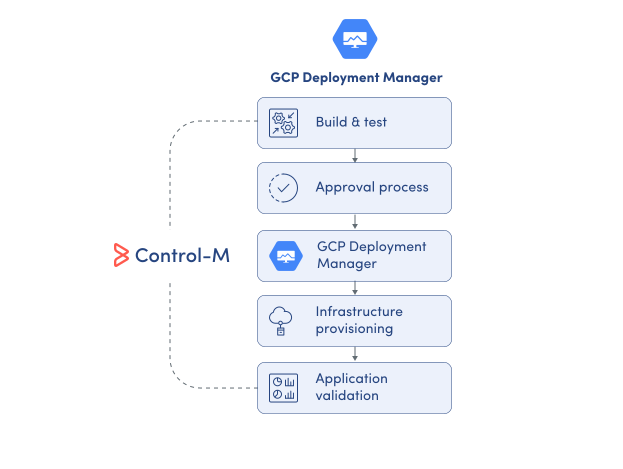
MONITOR DEPLOYMENTS
Monitor GCP deployments beyond Deployment Manager itself.
Deployment Manager exposes its own resource operations, but production changes depend on systems before and after infrastructure provisioning. Control-M provides centralized workflow visibility across deployment execution, surrounding dependencies, status, results, output, and service-level commitments:
-
Deployment execution status
-
Results and output monitoring
-
Cross-platform dependency visibility
-
Upstream failure awareness
-
SLA status tracking
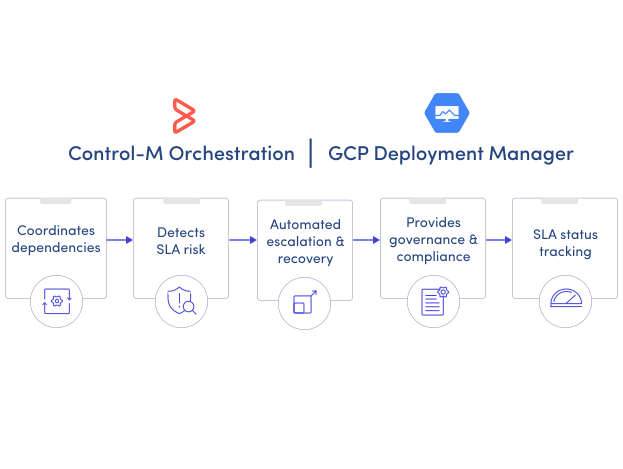
SLA ASSURANCE
Keep infrastructure-dependent releases inside their production window.
A successful infrastructure deployment does not guarantee the end-to-end release finishes on time. Control-M connects GCP Deployment Manager execution to the wider service workflow, applying dependency control and SLA management so teams can manage delivery against the actual production deadline:
-
End-to-end SLA tracking
-
Dependency-aware scheduling
-
Downstream cascade prevention
-
Centralized execution visibility
-
Coordinated recovery actions
Documentation
Bring order to complex workflows
Learn how Control-M helps teams orchestrate complex processes with greater visibility, coordination, and control.
