Let us know how we can help
Sales & Pricing
Speak to a rep about your business needs

Help & Support
See our product support options
General inquiries and locations
Contact us


 Control-M + Hive
Your Hive workflow starts before a Beeline job ever executes — and it can fail when something upstream breaks. An HDFS file expected by an HDFS File Watcher never arrives. A Sqoop import finishes late and leaves the Hive load waiting. Control-M orchestrates the full chain: HDFS data arrival, Sqoop ingestion, Hive execution, and downstream analytics delivery.
common workflow issues
Does this sound like your week?
HDFS DATA ARRIVAL
Your 2:00 AM Hive load started. The HDFS input never arrived.
Control-M can make the Hive job dependent on an HDFS File Watcher, so execution waits for the required data instead of relying on a fixed start time. The query starts only after the upstream file condition is satisfied.
SQOOP · HIVE
Your Sqoop import finished late. The Hive script is already due.
Control-M places Sqoop and Hive jobs in the same scheduling environment, evaluates the upstream job completion before releasing the Hive step, and preserves the dependency chain when ingestion runs late — avoiding brittle time-based coordination.
QUERY FAILURE
Beeline returned an error. Your downstream analytics job must not run.
Control-M monitors the Hive job as part of the workflow and prevents dependent processing from proceeding when its prerequisite fails. Operators can manage recovery centrally instead of allowing a failed Hive execution to cascade into downstream processing.
SLA RISK
Hive is still running. Your morning analytics delivery is approaching its SLA.
Control-M can attach SLA management to Hadoop workloads and track the Hive job inside the larger production flow. Teams gain visibility into delays and dependencies before a late query becomes a late business-data delivery.
SECURE EXECUTION
The Hive workload moved environments. Credentials are buried in another script.
Control-M uses a Hadoop connection profile for HiveServer2 connectivity, including Hive Host, Hive Port, Database Name, Hive User, Password, and the Hive Principal required for Kerberos authentication. Connection details stay separate from Hive job definitions, reducing repeated credential handling across scheduled workloads.
Control‑M + Hive
Control‑M + Hive
|
workload.types |
Hive Beeline jobs · Hive script execution · HiveQL queries · ETL processing · data warehouse loads · table/partition operations |
|
trigger.type |
HDFS file arrival · upstream job completion · time schedule · complex dependency · resource availability · workflow condition |
|
cross_tool.deps |
HDFS File Watcher · Sqoop job · Spark job · MapReduce job · Pig job · Oozie workflow · downstream Control-M job |
|
cloud.platforms |
Hadoop clusters (on-prem or cloud-hosted) · HDFS · HiveServer2 · Linux Control-M/Agent |
|
error_handling |
job status monitoring · downstream dependency control · advanced scheduling criteria · resource controls · SLA management · centralized recovery |
|
throughput |
distributed Hadoop processing · large data sets · batch ETL · Hive SQL processing · concurrent HiveServer2 workloads |
|
observability |
centralized job monitoring · workflow dependency visibility · SLA tracking · job output · execution status · historical workflow records |
end-to-end orchestration
One production workflow. Every tool in the stack.
Control-M orchestrates workflows across Hive, HDFS, Sqoop, and Spark — plus adjacent tools like Airflow and managed file transfers — in a single job flow, with dependency tracking, SLA visibility, and automated recovery across all of them.
- Cross-tool dependency: HDFS arrival → Sqoop import → Hive query → Spark analytics
- Data-aware triggers: HDFS file arrival, upstream job completion, API event, query completion
|
Hive |
Beeline job execution · Hive script execution · connection profiles · dependency management |
|
HDFS |
file arrival watching (HDFS File Watcher) · HDFS Commands · upstream data dependency control |
|
Sqoop |
import/export orchestration · dependency sequencing · job monitoring |
|
Spark |
Python jobs · Scala/Java jobs · cross-job dependencies |
|
Airflow |
DAG execution · status monitoring · enterprise workflow dependencies |
|
Managed File Transfer |
file movement · file arrival dependencies · secure transfer orchestration |
airflow coexistance
Control‑M doesn’t replace your Airflow DAGs. It runs the layer above them.
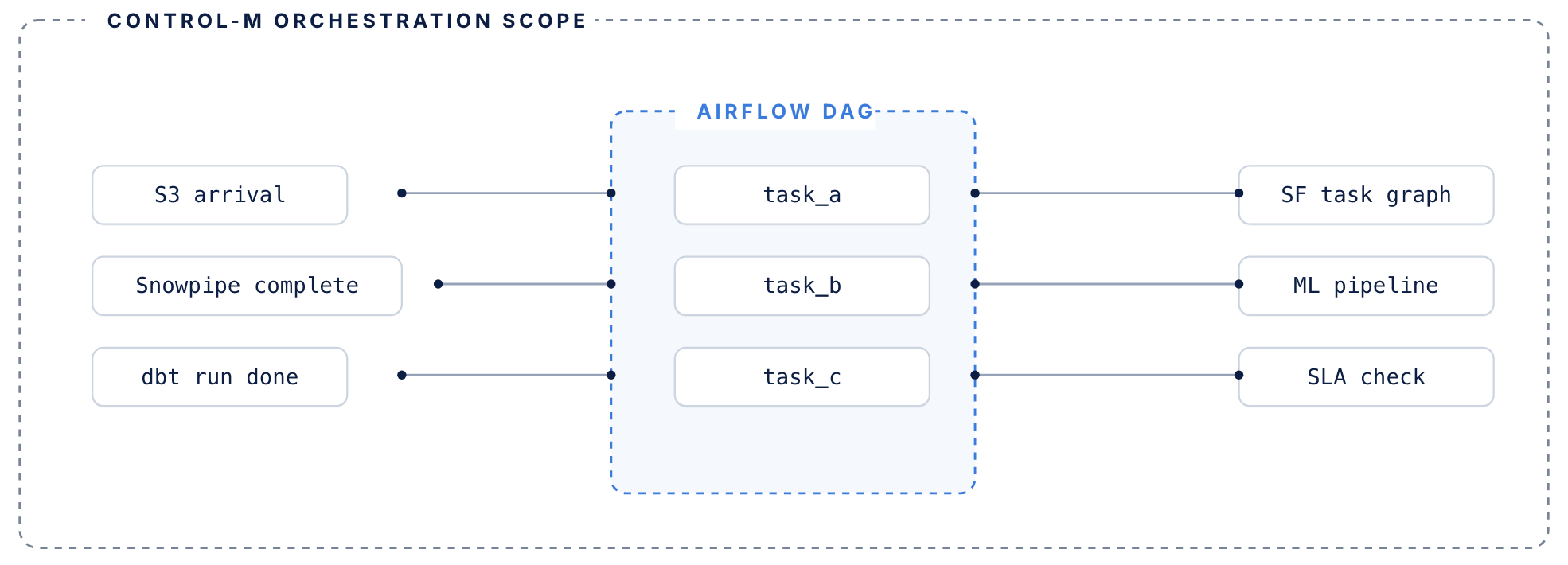
Airflow manages its DAG. Control-M manages everything surrounding it.
airflow handles
DAG-level orchestration inside the data pipeline
- DAG-level task orchestration within data pipelines
- Python operators, sensors, and task dependencies
- Execution graph for jobs that run inside your pipeline
- Manages retries within a single DAG context
control-m adds
The coordination layer around your DAGs
- Coordination layer around DAGs — triggers Airflow based on upstream conditions: file arrivals, API events, other tool completions
- Tracks each DAG’s SLA contribution across the full end-to-end workflow, not just its own routine
- Manages failure recovery when upstream dependencies fail before Airflow even starts
- Existing DAGs don’t need to be rewritten or migrated
MONITOR PIPELINES
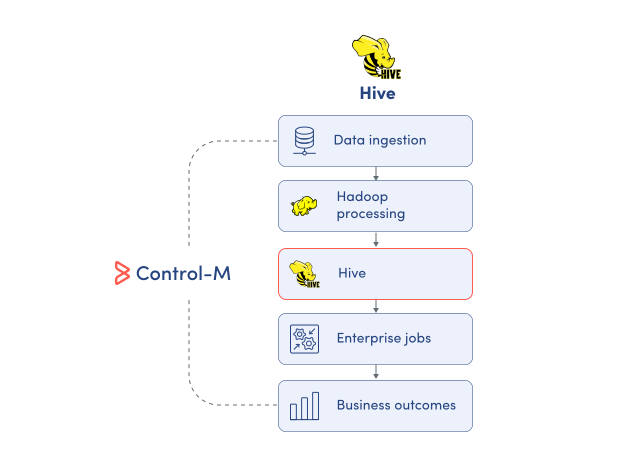
Monitor Hive execution across the full data pipeline
HiveServer2 enables remote clients to execute queries and retrieve results, but production delivery often depends on work outside Hive. Control-M brings Hive jobs and surrounding Hadoop and enterprise steps into centralized workflow monitoring so data teams can follow execution in context:
-
Hive job execution status
-
Upstream and downstream dependencies
-
Centralized workflow monitoring
-
Job output and results
-
End-to-end pipeline visibility
SLA ASSURANCE
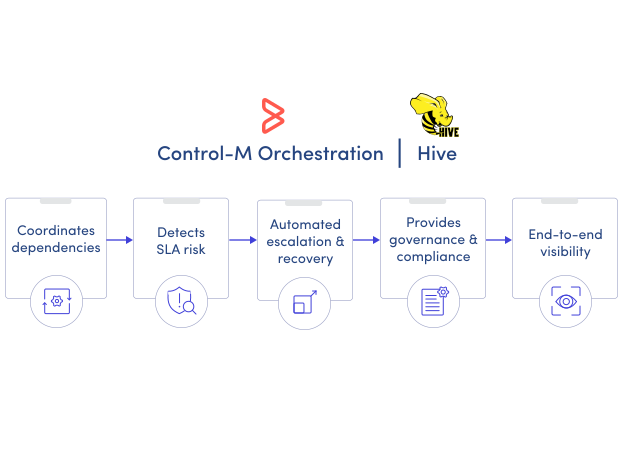
Keep Hive-dependent data deliveries on schedule
A successful Hive query is only one milestone in an end-to-end data service. Control-M adds SLA management across the broader workflow, helping teams identify dependencies and delays that put scheduled data delivery at risk:
-
End-to-end SLA tracking
-
Predictive delay detection
-
Complex dependency management
-
Centralized failure visibility
-
Advanced scheduling criteria