Let us know how we can help
Sales & Pricing
Speak to a rep about your business needs

Help & Support
See our product support options
General inquiries and locations
Contact us


 Control-M + Terraform
Your Terraform workflow starts before a workspace run ever executes — and it can fail when something upstream breaks. An AWS S3 deployment artifact never arrives. A GitHub Actions build finishes after the infrastructure change window. Control-M orchestrates the full chain: artifact arrival, application build, Terraform execution, and downstream deployment.
common workflow issues
Does this sound like your week?
These aren’t edge cases. They’re the normal operating conditions for teams running Terraform workflows across multiple tools. Here’s how Control-M handles each one.
UPSTREAM FAILURE
Your application build failed. Terraform is still scheduled for 2:00 a.m.
Control-M models the build and Terraform run as dependent jobs, so a failed prerequisite prevents the workspace from launching. Infrastructure changes wait for the required application state instead of executing because a disconnected schedule says it is time.
RUN FAILURE
Your Terraform run failed. Three downstream deployment jobs are still waiting.
Control-M triggers the Terraform workspace run (plan and apply) and gates dependent jobs on its completion status before releasing the downstream chain. A failed infrastructure run stops the downstream chain, containing the failure instead of allowing application deployment to continue against incomplete infrastructure.
CONCURRENT CHANGES
Two production changes are ready. Only one should touch the environment.
Control-M resource pools and lock resources add orchestration controls around Terraform jobs, coordinating execution when workflows compete for shared environments or resources. Teams can serialize critical changes and reduce collisions between independently scheduled production workflows
SLA RISK
The infrastructure run is late. Your 6:00 a.m. release depends on it.
Control-M can attach SLA management to the Terraform service and track the workspace run within the larger workflow. Operations teams see infrastructure delays in business-service context and can intervene before a late Terraform run becomes a missed delivery commitment.
MANUAL HANDOFFS
Terraform finished successfully. Someone still has to start the application deployment.
Control-M integrates Terraform jobs with other Control-M jobs in one scheduling environment. Successful workspace completion can satisfy the downstream dependency automatically, eliminating manual handoffs between infrastructure provisioning, configuration, deployment, validation, and other production workflow stages.
INTEGRATION FACTS
Control‑M + Terraform
|
API and automation capabilities |
Control-M Automation API · Terraform workspace creation (Terraform Cloud or Enterprise) · trigger a run (plan and apply) on a workspace · create parameters for workspace executions · define jobs in Control-M SaaS or Automation API |
|
Deployment models & infrastructure flexibility |
Control-M SaaS · Control-M self-managed · connects to any Terraform endpoint · Linux Agent · Windows Agent · single centralized scheduling environment |
|
Security posture |
Terraform credentials stored in a secure connection profile · connect to any Terraform endpoint · centralized connection profile management |
|
Incident response & MTTR enablement |
Control-M platform capabilities available around Terraform jobs: resource pools · lock resources · SLA monitoring · advanced scheduling criteria · failure tolerance |
end-to-end orchestration
One production workflow. Every tool in the stack.
Control-M orchestrates workflows across Terraform, GitHub, Jenkins, Ansible, cloud services, and application deployments in a single job flow — with dependency tracking, SLA visibility, and automated recovery across all of them.
- Cross-tool dependency: GitHub → Jenkins build → Terraform workspace → application deployment
- Data-aware triggers: artifact arrival, API event, build completion, workspace completion
|
Terraform |
run workspace · pass parameters · create workspace · create variables · monitor run status |
|
GitHub |
source-change workflow handoff · API-driven coordination · upstream dependency |
|
Jenkins |
build orchestration · completion dependency · downstream release handoff |
|
Ansible AWX |
launch job templates · configuration workflow coordination · status tracking |
|
AWS |
cloud-service orchestration · infrastructure dependencies · downstream workload execution |
|
Azure |
cloud-service orchestration · infrastructure dependencies · downstream workload execution |
|
Application deployment |
dependency gating · scheduled execution · SLA-aware workflow handoff |
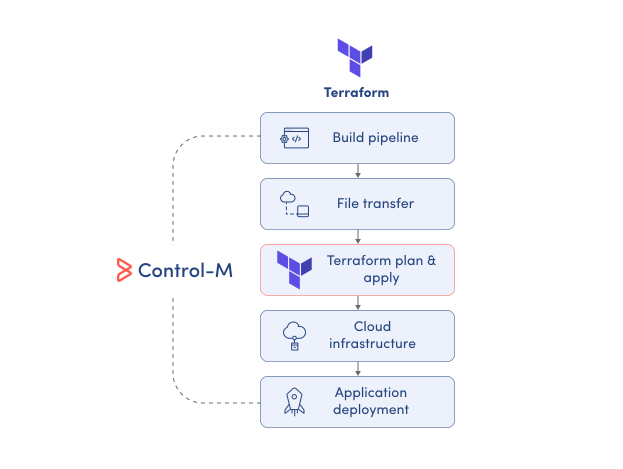
MONITOR INFRASTRUCTURE
Monitor Terraform runs inside the full production workflow.
Terraform shows what happens inside its workspace. Control-M adds operational context around that run, monitoring it alongside the builds, transfers, cloud jobs, and deployments it depends on or enables, so teams can track:
-
Terraform run (plan and apply) completion status within the flow
-
Upstream and downstream dependencies
-
Cross-platform execution status
-
End-to-end workflow progress
-
SLA risk and exceptions
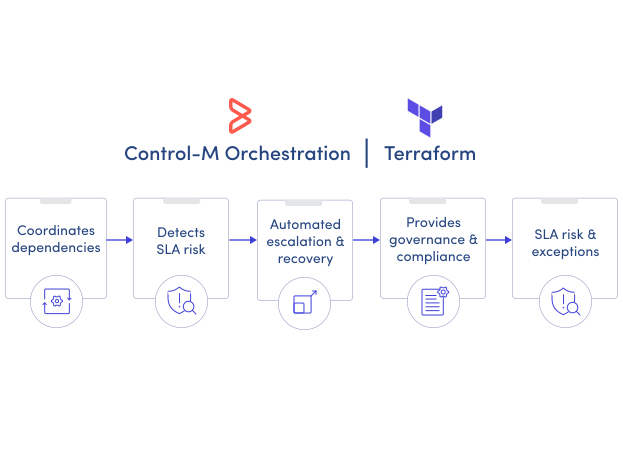
SLA ASSURANCE
Keep infrastructure changes aligned with delivery deadlines.
A successful Terraform run can still be too late for the service depending on it. Control-M connects infrastructure execution to end-to-end service timing, helping teams identify workflow delays and protect critical delivery commitments with:
-
End-to-end SLA tracking
-
Predictive delay visibility
-
Dependency-aware infrastructure scheduling
-
Resource and lock controls
-
Centralized operational monitoring
Documentation
Bring order to complex workflows
Learn how Control-M helps teams orchestrate complex processes with greater visibility, coordination, and control.
