Let us know how we can help
Sales & Pricing
Speak to a rep about your business needs

Help & Support
See our product support options
General inquiries and locations
Contact us


 Control-M + Talend OAuth
Your Talend Cloud workflow starts before a single task or plan is ever invoked — and it can fail when something upstream breaks. Failure 1: A source file that never lands in the S3 bucket your Talend job reads from. Failure 2: A Talend Management Console token that expires mid-run and 429-rate-limits every concurrent task. Chain: Control-M orchestrates the full chain: upstream file arrival, source data validation, Talend task/plan execution, and downstream delivery.
common workflow issues
Does this sound like your week?
These aren’t edge cases. They’re the normal operating conditions for teams running Talend tasks and plans across multiple tools. Here’s how Control-M handles each one.
TASK TARGETING
You set the task name but not the task ID. The job dies with "Job ID is not valid id."
A Talend backend API change made task-name-only jobs fail with a 400 error. Control-M's latest Talend OAuth plugin resolves the targeting logic so task name or task ID alone reliably fires the correct task — no false failures.
TOKEN RATE LIMIT
02:00 hits, every Talend job grabs its own token at once, and Envoy returns 429.
Concurrent Talend jobs each request a fresh OAuth token, bursting past the tenant rate limit. Control-M staggers execution and supports token reuse in the TDO042024 connection profile, so concurrent tasks share one valid token and the 429 burst disappears.
EXIT STATE INTEGRITY
Your Talend plan finished, but the Control-M job reports the wrong exit status.
A Failure Tolerance gap in the Application Integrator caused Talend jobs to end with an incorrect status. Control-M resolves this with the latest patch and a Failure Tolerance of 3, so the job's true exit state is always reflected downstream.
CREDENTIAL MANAGEMENT
Talend authentication changes. Your production schedules still need to run.
Control-M stores Talend OAuth credentials in a secure connection profile using Client ID and Client Secret authentication. External-vault support keeps secrets separate from job definitions, reducing credential handling inside production workflows.
SLA RISK
Talend completed successfully. The end-to-end delivery SLA is still slipping.
Control-M places the Talend job inside the complete production workflow and can attach an SLA job to it. Teams see Talend execution alongside surrounding dependencies, helping them manage delivery against the end-to-end business deadline.
INTEGRATION FACTS
Control‑M + Talend OAuth
|
workload.types |
Talend task execution (by task ID) · Talend task execution (by task name) · Talend plan execution (multi-task) · Talend Cloud data integration jobs · runtime API-triggered tasks |
|
trigger.type |
file arrival (S3 · Azure Blob · SFTP) · upstream job exit code · dbt Cloud run completion · API/webhook · time schedule · Talend task/plan completion event |
|
cross_tool.deps |
Apache Airflow DAG trigger · dbt Cloud run trigger · Snowflake/BigQuery load · Spark/Databricks job · REST API call · file delivery confirmation |
|
cloud.platforms |
Talend Cloud (Talend Management Console + runtime APIs) · Control-M Agent on AWS · Azure · GCP · on-premises (Control-M SaaS + self-hosted) |
|
error_handling |
configurable retry on HTTP code (Rerun Interval · Rerun Attempts) · configurable Failure Tolerance · downstream cascade prevention · automated job hold on upstream fail · Control-M SLA jobs · alerting via Control-M (email · ServiceNow) |
|
throughput |
batch and API-triggered task/plan execution · token-based OAuth 2.0 access · concurrency-aware scheduling to respect Talend API rate limits |
|
observability |
job-level audit log · Talend plan/task run status · SLA tracking with breach prediction · dependency lineage across the Control-M flow · Control-M-native monitoring |
end-to-end orchestration
One production workflow. Every tool in the stack.
Control-M orchestrates workflows across Talend OAuth, Snowflake, Databricks, dbt, file transfers, and cloud services in a single job flow — with dependency tracking, SLA visibility, and automated recovery across all of them.
- Cross-tool dependency: file arrival → Talend task → Snowflake load → analytics handoff.
- Data-aware triggers: file arrival, API event, upstream job exit code, Talend plan completion
|
Snowflake |
coordinate transformations · manage dependencies · track completion |
|
Databricks |
orchestrate jobs · coordinate dependencies · monitor execution |
|
dbt |
coordinate model runs · track completion · gate downstream work |
|
File transfers |
detect delivery · trigger processing · coordinate handoffs |
|
REST APIs |
invoke services · coordinate application steps · connect workflow stages |
|
Talend Cloud |
execute task by ID · execute task by name · execute plan (multi-task) · OAuth 2.0 token management · rate-limit-aware scheduling |
airflow coexistance
Control-M doesn’t replace your Airflow DAGs. It runs the layer above them.
The objection is common: “We’re already on Airflow.” The issue isn’t what Airflow does – it’s what happens before and after Airflow runs. That’s where pipelines actually fail.
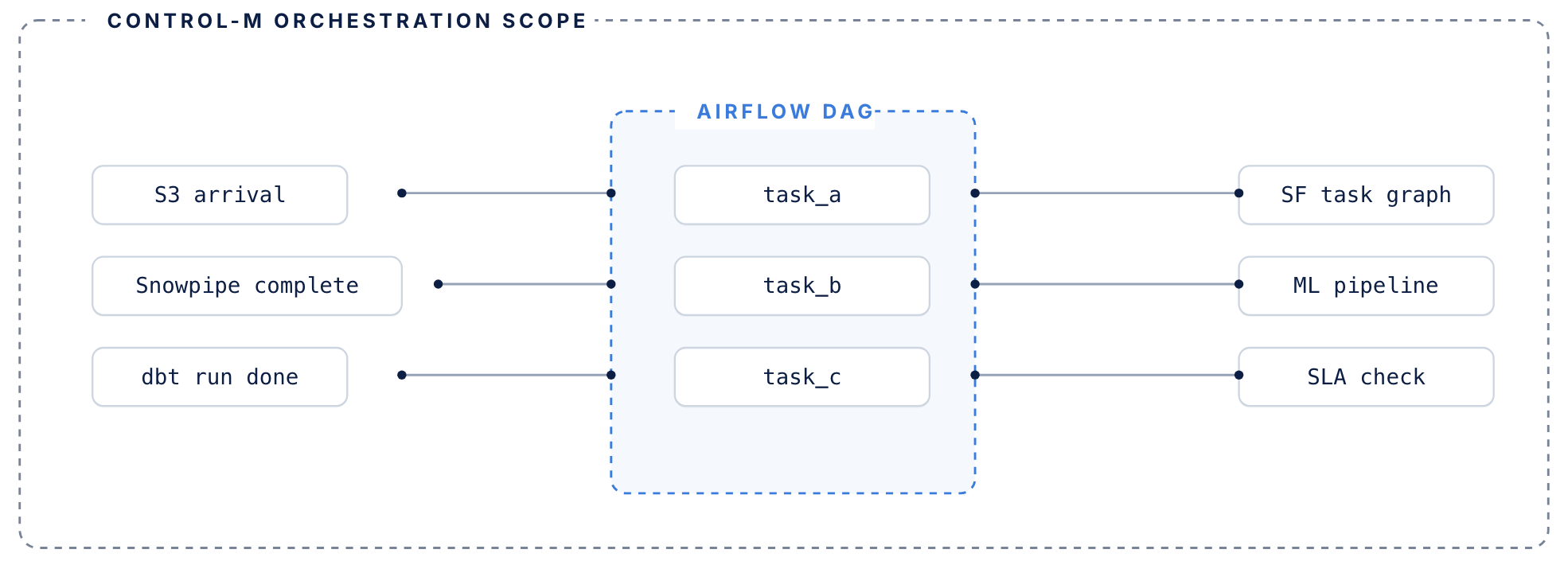
Airflow manages its DAG. Control-M manages everything surrounding it.
airflow handles
DAG-level orchestration inside the data pipeline
- DAG-level task orchestration within data pipelines
- Python operators, sensors, and task dependencies
- Execution graph for jobs that run inside your pipeline
- Manages retries within a single DAG context
control-m adds
The coordination layer around your DAGs
- Coordination layer around DAGs — triggers Airflow based on upstream conditions: file arrivals, API events, other tool completions
- Tracks each DAG’s SLA contribution across the full end-to-end workflow, not just its own routine
- Manages failure recovery when upstream dependencies fail before Airflow even starts
- Existing DAGs don’t need to be rewritten or migrated
MONITOR PIPELINES
Monitor Talend task and plan status, results, and output in one place
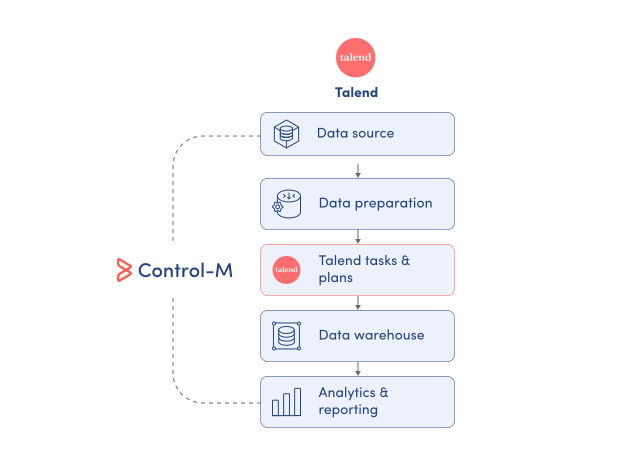
Talend execution is only one stage of a production data pipeline. Control-M provides a centralized view of Talend jobs alongside the upstream and downstream work they depend on, giving DataOps teams operational context across the workflow:
-
Task and plan status
-
Results and job output
-
Task and failed-plan logs
-
Upstream and downstream dependencies
-
End-to-end workflow status
SLA ASSURANCE
Keep Talend pipelines aligned to business deadlines
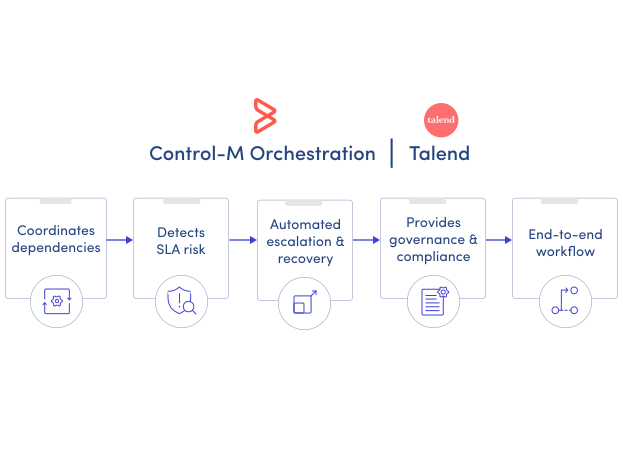
A successful Talend task does not guarantee that the complete data pipeline will finish on time. Control-M connects Talend execution to surrounding dependencies and SLA management so teams can manage the delivery deadline across the entire workflow:
-
End-to-end SLA tracking
-
Cross-platform dependency visibility
-
Upstream failure detection
-
Downstream execution control
-
Centralized workflow monitoring
Documentation
Bring order to complex workflows
Learn how Control-M helps teams orchestrate complex processes with greater visibility, coordination, and control.
